
AI In Libraries
Jaylei Davis | Sept. 15, 2026
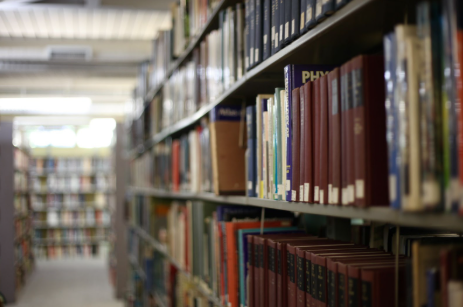
Bookshelves at Pew Learning Center and Ellison Library at Warren Wilson College, on Sept. 4, 2026 in Swannanoa, N.C. (Vivian Bryan/Echo)
People worldwide have heard of the Nazis destroying books when they came to power in Germany in 1933 to get rid of anything that did not fit their ideals. What if it’s been reported something similar is happening right now in the United States of America and that it affects how the country keeps information?
Since 2024, Anthropic – an AI company – and its CEO Dario Amodei, in partnership with Meta and its CEO Mark Zuckerberg, have been destroying millions of books, after scanning them into their AI Large Language Model (LLM). The process begins via the use of Amazon warehouses where the purchased books are taken and then transported to an Anthropic warehouse for scanning and destruction.
Anthropic launched Project Panama with one goal in mind.
“[Project Panama is] our effort to destructively scan all the books in the world,” Anthropic's internal planning document stated.
The process the company uses to complete this project is simple. Anthropic buys large palettes of books from retailers and downloads books from pirated websites, notably: The Shadow World. The books are then taken to an Amazon warehouse where they are sorted before being transported to Anthropic’s warehouse where the scanning and cutting of the books take place. Then Claude is trained on the scanned books and the cuts of the books are recycled.
Where are these now digitized book copies going? We as the public do not know yet, but the information is not staying within the AI model. They are not built to keep the entirety of a book within their database.
Michael Mars Landis, the Information Technology Director at Warren Wilson College (WWC), explained that AI LLMs are based on the neurological pathways of a human being, so they recall memorized lines of information.
“You cannot go find a copy of any particular thing that a model is trained on inside the large language model’s weights,” Landis said. “There is no copy of any work in an LLM that the LLM was trained on.”
How does this affect libraries? Libraries are a hub for people to come and browse books they want, without the complication of technology. With Anthropic being on a mission to destroy and scan books into AI, lots of physical copies are being lost. This affects the literature market economy – and its benefactors – as a whole. More specifically, Project Panama will affect large research libraries which then trickles down to affect smaller university libraries due to the process of Interlibrary Loan, which librarians at WWC use to access books not within the library system.
David Bradshaw, Electric Resources Librarian & Director of the Sound Lab, noted that while Warren Wilson is a college that does research to answer big questions, the library is one dedicated to the needs of students
“Academics use the term ‘research libraries’ (referred to as R1s) to designate the large university libraries that have enormous library collections to support all of the research that happens at those places," Bradshaw said. “That's different from a small college library like here at Wilson, where we primarily support the current, largely undergraduate, academic programs."
Anthrophic’s Project Panama is a fairly new problem, with it only being two years old, so it has not reached the shore of WWC yet. Project Panama is not changing the immediate scope of WWC's campus yet AI is. The specifics of AI in effect within WWC’s library is based on the databases school libraries buy in order to help their students.
Julia Haverstock, Director of Pew Learning Center & Ellison Library, explained how student libraries are given access to books by databases the school invests in and books the librarians buy.
“Databases control what we have access to,” Haverstock said. “We pay them for that service, so you can pay more money to have more access. There already is sort of a tension between companies that we buy our information from and users and librarians.”
The information that libraries obtain via these databases is not controlled by the libraries or the school. With AI tools changing the landscape of life, WWC library has recently, as of Sept. 2, introduced AI tools that are being integrated into the library. The specific databases of concern to WWC are: EBSCO, Google Scholar and its program Quick Read and ProQuest.
Many students on campus have already spoken out about how they feel regarding the introduction of AI into the library and how it might affect future generations. Fern ‘Mirage’ Parker, a freshman WWC student, said she wishes for regulation of AI towards a 50-50 compromise between technology and the physicality of the world.
“I feel like we're losing what's good about libraries and what's good about all that wonderful stuff, books,” Parker said. “I feel like they're good side by side, but it shouldn't be one or the other, we should have an equal standing between technology and [physical copies]”
AI is quickly becoming something we see within everyday life. For written works, AI has been seen to be working within a detrimental system, yet AI has also been proven to help many students. Students have turned to AI in order to do research, start writing a paper and to help with studying. WWC is taking great strides in ensuring that AI is being introduced into the college, keeping up with the world around them, while strongly establishing regulations to ensure that AI does not become harmful to the college, such as the Human Intelligence Commission. The Commission is made up of students and faculty who will work together to plan the next steps in AI integration at WWC.