

To Park or Not to Park?
Ansley Pate | Sept. 15, 2026
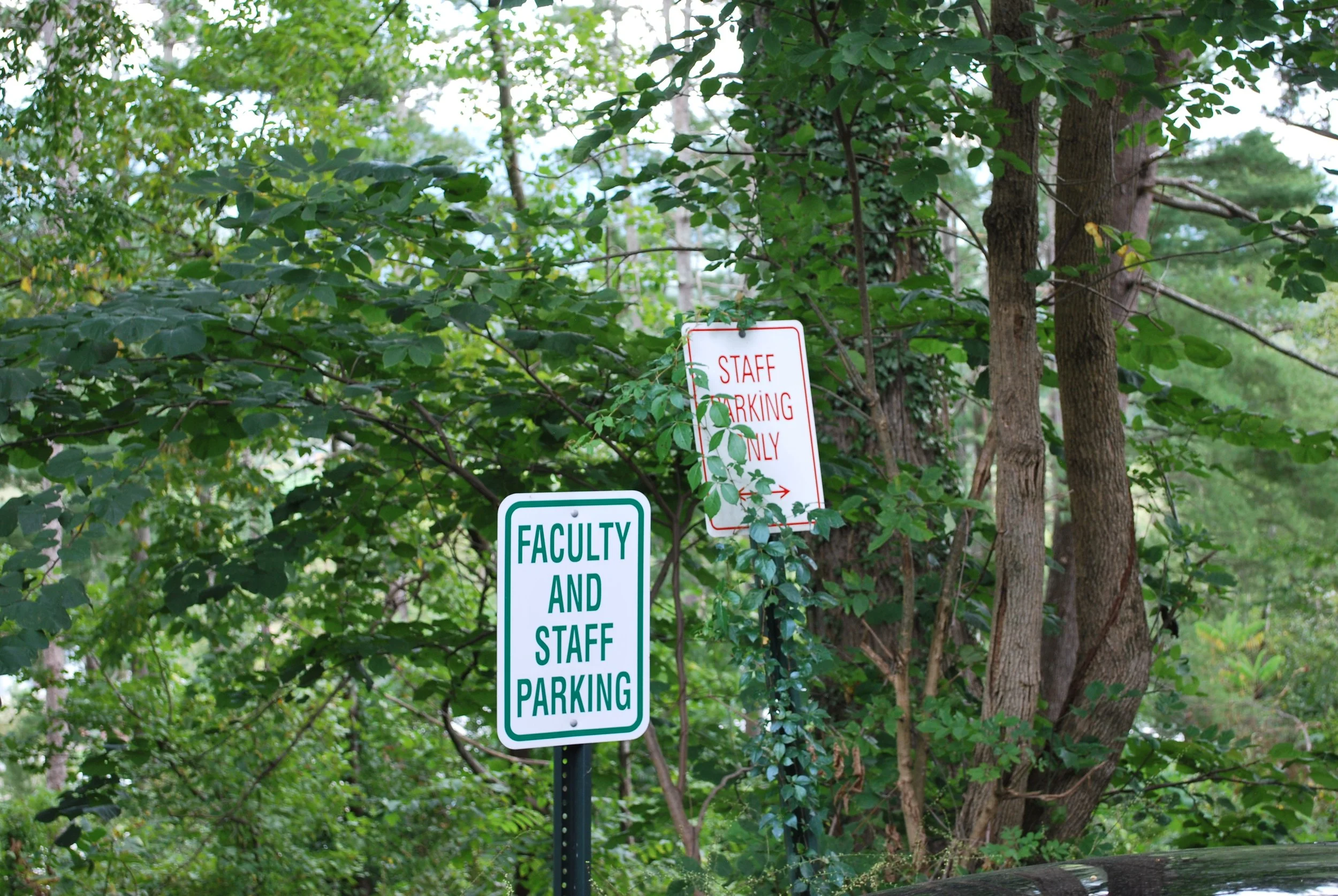
Signs that state ‘Faculty and staff parking’ and ‘Staff parking only’ on the Warren Wilson College campus, on Sept. 8, 2026 in Swannanoa, N.C. (Echo/Finn McKenny)
Warren Wilson College (WWC) is home to roughly 800 students and stands proudly surrounded by the Blue Ridge Mountains. It spans across more than 1,000 acres of land, consisting of lush forest, farmland, gardens and… 691 parking spaces.
Main campus houses all of the college’s instructional buildings, dining halls and about a third of the student housing buildings. Most of the parking on main campus is reserved for staff, save the gravel lot behind Boon Hall from the hours of 6 p.m. to 6 a.m. and the lot at the rear of Kittredge Theater, the front portion of which is also reserved for staff. The Kittredge lot serves as the primary vehicle housing for Sunderland and Vining residents, and for those residing on the other side of campus who opt to drive closer to class during the day. Due to the variety of people who park in the lot, Kittredge is subject to reach max capacity very quickly. Many students at WWC find this arrangement to be unjust, and simply put, inconvenient.
According to Google Maps, the average distance across main campus from housing to the academic facilities is about a fifth of a mile, and from the housing on the secondary campus it nearly doubles, averaging close to half a mile. While both are seemingly short walks, the terrain on campus can make the journey feel a lot longer than it really is. The walk from virtually anywhere on campus includes a multitude of steep hills and staircases, which become even more intimidating in the warmer seasons, leaving students to make their entrance to class flushed and out of breath.
Gabe Ranke, a senior at WWC, said he does not mind the walk, but it usually makes him late for his early-morning classes.
“I’m used to it at this point,” Ranke said.
Another student, Christian Guzman, also attested to the lack of accessible student parking spaces.
“To be a little blunt, I feel like there could be a lot more spots [available to students], especially with the distance between [housing] and classes,” Guzman said.
This will mark Guzman’s first semester at WWC after transferring from Guilford College in Greensboro.
“[The parking there] was much more efficient,” Guzman said. “There was a lot more student [parking] than faculty.”
Guzman currently resides in the Elmslie building, located on the secondary campus. He is among the many students who have opted to walk to class to avoid the hassle of searching for parking.
For those who continue to fight for parking on campus, doing so in zones or during times where it is prohibited can result in tickets starting at $75. The cost of a ticket can rise into the hundreds of dollars should the ticket issuer find the individual to be in violation of more than one policy. These prices become especially daunting when paired with standard tuition rates and loans.
Ranke detailed his own encounters with the parking administration.
"During my sophomore year, they put the staff and faculty signs next to Vining,” said Ranke. “Those all used to be open for students. [They're] not anymore, which I think is ridiculous. So then everyone had to park at Kittredge. [Vining is] where I got half of those parking tickets, just parking next to my building."
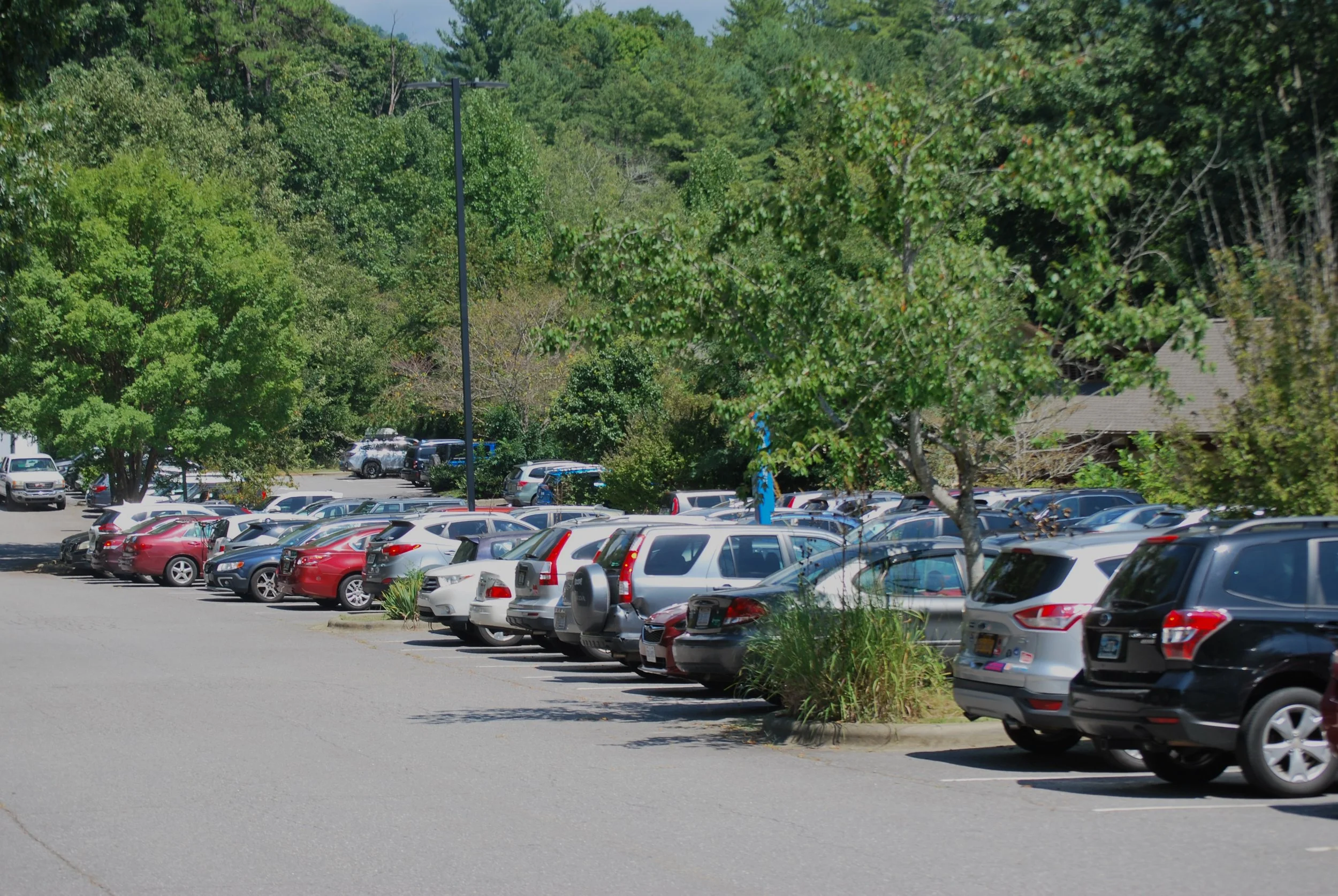
Student parking in the Kittridge Theater parking lot on Warren Wilson College campus, on Sept. 2, 2026 in Swannanoa, N.C. (Echo/Finn McKenny)
Head of Public Safety, John Davidson, however, contended that the parking spots next to Vining were never open to students.
“Sunderland and Sunderland wall [have] always been faculty and staff [spots].” Davidson said.
Jacob White, a junior at WWC, shared his thoughts on the ticket system.
“I think the ticket amounts are kind of insane, like how much you have to pay just because you parked in a staff spot when a staff member would not be using [it],” White said. “That whole row outside of Sunderland, across from Vining, would be empty if students didn’t [use it]. You’re really not doing any harm parking there, and yet you still get a $300 ticket.”
Some students have even resorted to going off-the-grid, not registering their cars to avoid these fines being placed on their student accounts.
“I got a new car my sophomore year, and I didn’t register it with the college,” said a WWC student who wishes to remain anonymous. “I’ve just been parking wherever I want ever since. They give me tickets, but they can’t put that on my account because they don’t know whose car it is.”
A former student, who has also asked to comment anonymously, recounted their own experience with the parking administration, claiming to have received notice that their diploma would be withheld until they paid the school thousands of dollars worth of parking tickets, only a couple of weeks away from walking the stage for graduation. Having been utilizing the same off-the-grid tactic as their peers, they thought they were certain to be safe from incurring fines before receiving the notice.
“I don’t know how they figured out [it] was my car,” said the unnamed individual, who urged current students to proceed with caution. “Be careful, because they will get you.”
Davidson echoed the anonymous student’s warning and further emphasized the impact of unregistered vehicles on campus.
“In a year, [we administer] well over a thousand or more [parking tickets]. Most of those tickets are people who won’t register their vehicles.” Davidson said.
He also pointed out that, as of this current fall semester, the number of cars registered to the college is still in the two-hundreds.
Davidson acknowledged the parking constraints on behalf of the administration, stressing that it is simply just policy, and emphasized that the Public Safety team works consistently to enhance the walkability and safety on campus.
For some students at WWC, it has become easier to take the scenic route and try to make use of these features. Others still want the convenience of parking close to where they need to be. Meanwhile, the Public Safety team must proceed with their responsibilities. But there is a balance to be found between maintaining order and making room for the people the campus is built around. Students and faculty may not yet agree on where that balance lies, but until they do, these frustrations will remain.