

Meet The Minds Behind WWC’s New $350,000 Grant
Elliott Hove and Emma Taylor McCallum | Sept. 15, 2026
On Aug. 19, 2026, Warren Wilson College (WWC) notified its student body that the institution had received an almost $350,000 Institutional Impact grant from the Educating Character Initiative (ECI), “a project of the Program for Leadership and Character at Wake Forest University to advance an educational model connecting environmental stewardship, service and civic responsibility.” Funded by Lilly Endowment Inc, it is the largest competitive grant received in the institution’s history.
The Institutional Impact grant to WWC focuses on “Cultivating Climate Character: Relational Stewardship and Citizenship,” and has three different focuses: building character and leadership; climate stewardship and civic environmentalism; and cultivating knowledge through place-based, indigenous storytelling.
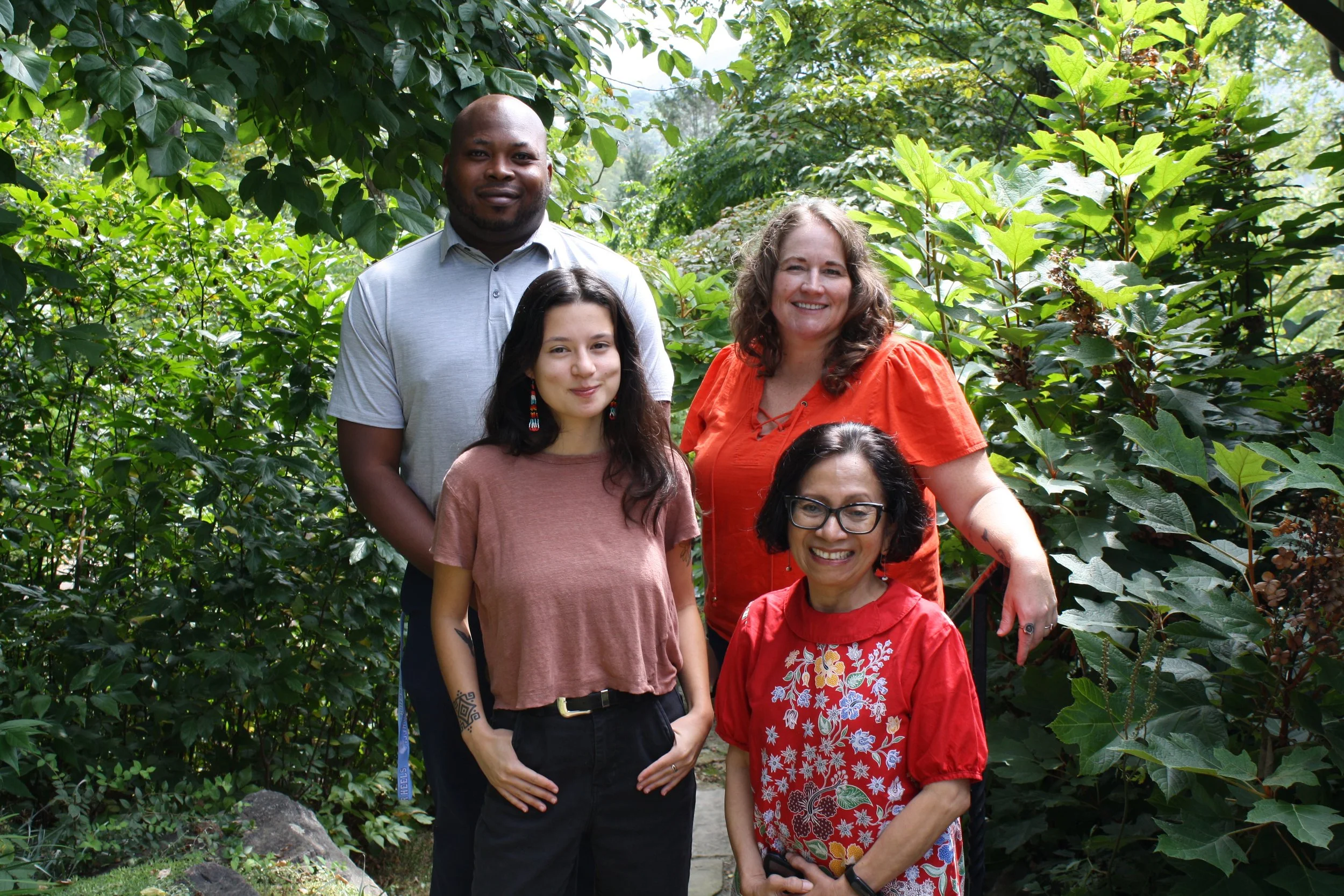
Left to right, back to front, Evan Snelling, Dr. Scotti Norman Jetta Ghosthorse Aranda, and Dr. Siti Kusujiarti, the team behind the ECI grant at Warren Wilson College Sep. 15, 2026, Swannanoa, N.C. (Echo/Emma Taylor McCallum)
The Grant Proposal Process
A strong interdisciplinary approach was required in order to synthesize the expansive scope of the grant, with a nine-month proposal process. Dr. Siti Kusujiarti, Professor of Sociology and Chair of the Department of Social and Cultural Studies, explained how the grant proposal required the same cross-campus collaboration that it seeks to promote.
“I would like to emphasize that this [was] a truly collaborative effort with [everyone] involved,” Kusujiarti said. “It's not something that we suddenly got. It's based on a lot of work, with many other people getting involved.”
A unique dimension of the grant was its focus on place-based knowledge and storytelling. Dr. Scotti Norman, Assistant Professor of Material Culture and Archaeology, said that the impetus of integrating this focus into the grant was spurred by Hurricane Helene.
“Following Hurricane Helene in 2024, Siti, myself and a lot of students, too, felt like maybe Western notions of individualism and rationality were hard to understand in the wake of such devastating tragedy,” Norman said. “I just remember thinking, in the absence of top-down organization, the only way we survived was… through mutual aid, helping one another, through knowing the land well. We thought that would be an interesting non-Western way that we could pursue character.”
This concept of character around climate was all too familiar to Jetta Ghosthorse Aranda, Coordinator in the Office of Inclusive Excellence and Assistant Programmer for the WWC ECI grant. She noted how the grant process was intertwined with and largely framed by her capstone, which focused on storytelling and place-based knowledge in Swannanoa after Hurricane Helene. Place-based knowledge refers to the traditional ecological epistemology that is intrinsic to local areas and has been passed down through multiple generations.
“We started doing interviews with some people who decided to stay after Helene, who volunteered to stay amidst having no power, no water…” Ghosthorse Aranda said. “Contributing to this community made them feel like this place is home. They [wanted] to protect it and be good stewards. And that's an ethos of this college in general.”
Norman highlighted how storytelling not only builds character, but builds stronger, non-hierarchical relationships in community. This is a key component of the grant’s intended impact on WWC campus.
“We develop these things together, where students are also co-creators of knowledge, and will be treated as full participants,” Norman said. “In that way, we [will] produce a group of people that can think about how we display knowledge and how we display our relationships with others in our community.”
The Challenges of Educating Climate Character
The grant writing process was not without its challenges, especially when working across departments while trying to embody the collaborative values that are central to the grant.
“I will say there's also this other specter of efficiency and thinking… about academic integrity, scholarly integrity, how we are defining… this project in a world where we're facing a lot of outward pressure to use things like AI,” Norman said. “We really saw it as part of our ethical imperative to draft this collaboratively, with one another, talking with people face to face, brainstorming ways we could benefit the greater good at our campus.”
Kusujiarti also discussed how challenges of collaborative, non-hierarchical work extend beyond the WWC campus.
“Higher education is built in [this] kind of very stratified way… We always talk about decolonizing higher ed or decolonizing our work… this is actually the work of decolonizing,” Kusujiarti said. “How we actually practice decolonization is to challenge the way that we work, challenge the way that different people, different voices are integrated into the process… We are basically challenging the existing structure in general.”
Ghosthorse Aranda further highlighted how this work challenges dominant narratives of character and climate.
“There's a misunderstanding that climate is not very intersectional, [or that] climate is [just] the state of an environment or the patterns in an environment,” Ghosthorse Aranda said. “But [climate] includes people.”
What ECI Means for WWC
While these large-scale challenges remain, it is important to note what ways the grant will benefit the WWC campus. Evan Snelling, Assistant Dean of Students, Inclusive Excellence and Belonging, described what the exploration of “character” might look like for the WWC student body. His role in the grant was focused primarily on inclusive excellence, leadership and character development.
“Character is a word used [so] often, but we really want to find ways for students to deep dive into what character is, how [do] you develop or grow character,” Snelling said.“That's one of the facets that really drew me.”
Snelling also described actions and programming on campus that the student body can expect to see in the coming semesters.
“We're going to bring speakers to campus,” Snelling said. “[ECI] is a three-year grant… I'm hoping by the end of spring 2027 that we've really hit our stride and we're finding ways to not only embed it into orientation, but we find a way to spread the message [of] the grant to all students.”
Another initiative supported by the grant is the Place-Based Storytelling Fellowship Program which is open to staff, faculty and students.
“If you're thinking about ways to talk about place, climate… [or] relationships, this would be a really great fellowship for you,” Norman said. “You [will] get the chance to share part of yourself and learn from other people. Part of it will be leading a couple of sessions of the fellowship.”
The application form for the fellowship will open on Oct. 8 and will close on Oct. 31, 2026. The cohort will be announced by the end of November.
The work under the ECI grant will also collaborate with other existing initiatives on campus including the Democracy in Action Initiative and the Right Relationships Committee, as Kusujiarti described.
“For us, collaboration is key,” Kusajiarti said. “This is not an individualized project.”
The ECI grant can be expected to provide a nuanced, interdisciplinary approach to engagement across WWC campus. The grant blends character building, climate stewardship and place-based storytelling. This multifaceted approach is summarized by Ghosthorse Aranda:
“There is memory held in this land that we as a community are responsible for caretaking. [Without that caretaking], we are doing a disservice not only to it, but to ourselves,” she said.