

“Get an Adderall Prescription. Jazz Works Too.”: Do Wilson Students Study With Music?
Angel Alvarado | April 21, 2026
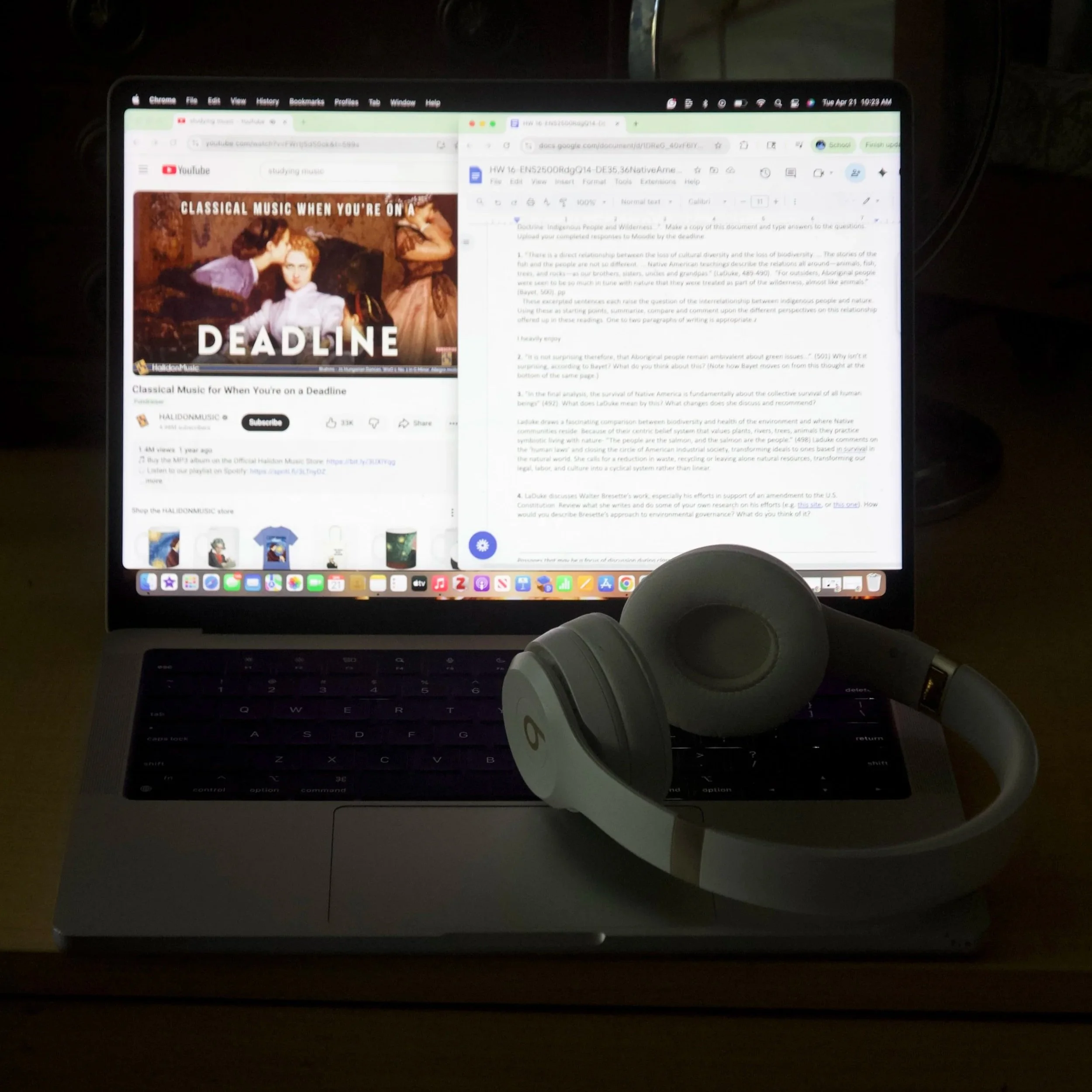
A set of headphones rests on a laptop displaying a paper and a YouTube video titled “Classical Music for When You’re on a Deadline” at Warren Wilson College (WWC) in Swannanoa, N.C. (Echo/Richmond Joyce)
During finals season, it would be an understatement to say that many students struggle with studying and getting work done. Whether it be by finally doing chores you otherwise would ignore, or by unintentionally getting distracted with doomscrolling, procrastination opportunities abound. You might find yourself scrolling through social media for five minutes, which suddenly turned into an hour-long deep dive into a rabbit hole that got your attention. All this, ultimately, leads to you begrudgingly sitting yourself down and trying to lock in on studying with lo-fi in the background as a last resort. Perhaps it's Coconut Mall being played on repeat. But does the music really help you focus?
Music, in general, has been shown to affect the brain and its structures, such as the hippocampus, which is involved in memory consolidation and spatial learning. It recognizes the familiar or perhaps unfamiliar songs and ties them to, or brings back, the emotion felt when you first listened to them. The prefrontal lobe, when studying, helps with focus, attention, planning, organizing and working memory- all of which allow you to hold information in mind while processing it.
Recently, a questionnaire was sent out to students at Warren Wilson College (WWC) about their listening activity while studying or working. Although only 24 students replied in total, there was a lot of diversity in the data collected. The questions asked included whether students actively listened to music to the genre that they tended to listen to.
The data showed that 45.8% of student respondents always listen to music while working or studying to fill the silence. 4.2% firmly don’t listen to music while working, finding it distracting. About 48.5% of students who listened to music said it boosted their concentration and reduced the time it took to study or work, but 25% didn’t notice any difference, and 25% didn’t think it made any difference.
The question that initially sparked my curiosity also had the most varied answers was about genres. Respondents reported listening to a wide range of genres, with the survey also giving students the option to write in their own genre if a student preferred a genre that wasn’t present. What was hypothesized for the students who listened to music while studying/working was that the genre would be low-energy and calm; perhaps instrumental sounds like jazz, lo-fi, classical or soundtracks. Results showed that students actually preferred more upbeat and fast-paced music, such as rock, EDM, dance, rap and hip-hop. Interestingly enough, regardless of genre, many students agreed that they preferred to listen to instrumental music, as the words were too distracting to them.
Among the recommendations students gave, there was a recurring theme of listening to music that had no lyrics, among other suggestions such as lower volume to just barely stimulate their attention or repeating a single song or album while you work. One student humorously added to “Listen to your doctor and get an Adderall prescription. Jazz works too.”
Research conducted on the relation between music and studying has shown that although music can be beneficial and help with concentration, many factors play into whether it works for you or not. For example, to find what sound works best for you, it may depend on what you are working on; whether it's a writing assignment or memorizing class material, as well as what type of learner you may be, visual, auditory or kinesthetic. It all comes down to testing different genres, volumes and tempos to see what works best for you, as everyone is different in their music taste and emotional response to their music.
Something I would recommend when it comes to studying in general is to change your space. Staying in the same space where you relax and sleep can make you less productive, as you have the quick escape of lying in your bed for a five-minute break, only to wake up the following morning, having done no studying or work before promptly passing out.
Elliott Hove is a junior and tutor on the Academic Support crew, which helps students with scheduling and managing the obstacles that may get in the way of their schoolwork. He commented that he enjoys listening to instrumental music while he works, finding himself working in the library, outside, or on the first floor of Jensen. He has observed that staying in his dorm causes him to become frequently distracted and get tired as he works.
Hove recommends that students take advantage of the studying spaces on the first floor of Jensen, as it isn’t frequently visited and serves as a great space to get work done.
“Please come down to the first floor of Jensen,” Hove said. “[The Academic Support crew’s] hours are from eight in the morning to five in the afternoon. It's a little quiet, but there's always somebody there. If you need to take your final exam in a space that's not the classroom, there are final exam rooms, and I highly recommend them.”
Overall, music can play an important role in how students study, but it varies from person to person. Some students prefer soft, calmer music to listen to while they work to concentrate, and others prefer loud, upbeat music to get themselves hyped up enough to finish their work efficiently. Try new genres, sounds, artists, rhythms or just listen to the ambient sounds of your surroundings- whatever helps you best get things done.