

What Did We Learn From COVID-19?
Angel Alvarado | April 7, 2026
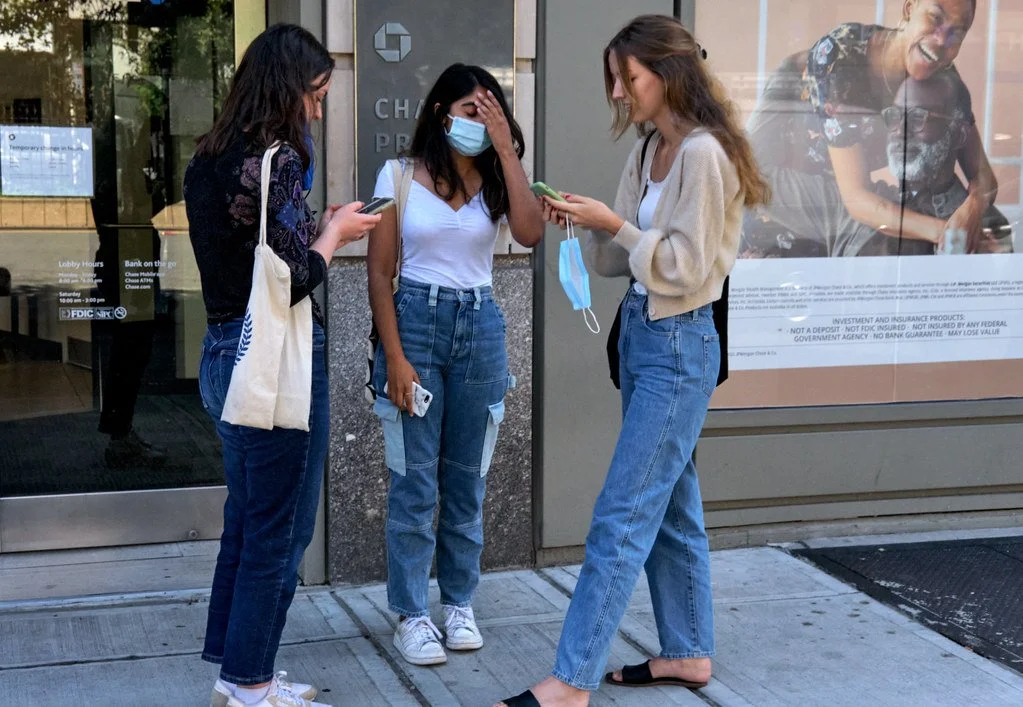
Three women with masks stand talking while on phones in New York City, N.Y. on Sept. 2, 2021.
Six years ago, in March 2020, Buncombe County students were told they would have a two-week break due to the threat of a viral, highly contagious respiratory illness called COVID-19. Although many students were just happy to have a break before finals started, there was an underlying sense of uneasiness- rightfully so, as the two-week break turned into more than a year of online schooling for many students all over the world.
COVID-19 had many effects on virtually all students, from their education to their mental and physical health. In general, the biggest impacts COVID-19 had on students were their social and emotional development, along with learning losses and personal mental health crises.
Ava McKinney-Taylor, a sophomore student, a ninth grader in Atlanta, Georgia, when the pandemic began, was already homeschooled through a program called Sora. She explained how her online school’s structure adapted to their small classes filling up dramatically, leading the school to hire more professors with more specialties to accommodate the growing number of students.
McKinney-Taylor also mentioned that by the end of the spring semester, around April of the same year, things seemed to go back to normal for the students who switched to online learning, as those students returned to in-person classes. This was startling for her, knowing the seriousness of the illness after having been one of the first COVID-19 cases in their city.
Though McKinney-Taylor improved, they still found themselves experiencing symptoms after the virus had run its course, like chronic exhaustion, aphasia, brain fog and immune issues along with their asthma. These issues worsened along with their EDS (Ehlers-Danlos Syndrome, a genetic disorder affecting connective tissue, primarily collagen). This led to their diagnosis of Long COVID, which got them featured in the New York Times as one of the first “long haulers”.
McKinney-Taylor described how they lost many friendships because people were unwilling to take any COVID precautions, adding stress to her already disheartened state.
“I was deeply unhappy,” McKinney-Taylor said. “My body had pretty much entirely failed. I'd always had EDS. I managed it really well, but this was different. I was a very active person and was very social, and I had turned into a sickly Victorian child. I was sleeping my days away. I was barely getting enough energy to eat. My mother told me that she was worried I was just not gonna wake up one day, and I was having people around me engage in so much petty teen trauma, and in the middle of it, which wasn’t needed. They would say ‘I feel like you're not making enough time for me’ and I'm just like, ‘I don't know if I'm going to be here tomorrow morning.’”
Finn McKenny, a first-year student who was a seventh grader in Alabama during the pandemic, described how their school made Zoom attendance optional but all the school work was required in addition to gym classes, for which he humorously mentioned that his camera “somehow never worked.” Students were allowed to go back to in-person classes the following year, which McKenny declined, deciding to stay online because they did not want to risk getting sick.
McKenny added that she felt like nobody got a full education during that time or even had the motivation to learn or teach.
“We didn't get a complete education,” McKenny said. “The teachers didn't want to do it anymore; they didn’t want to be there. Telling us to, ‘Just do this. Stay on for like 30 minutes. Let me call roll.’ No one wanted to be there. So I think going into high school, you're learning again and it was a total whiplash.”
Mariella Weathers, a first-year student, who was an eighth grader at that moment the pandemic hit, described how her school switched to online learning for a while. Then, her school decided to go hybrid, meaning classes were both in person and online, with students' last name dictating their t specific days to attend classes in-person.
Weathers described her transition to being online and isolated as a difficult one, making her feel out of place.
“It was difficult and I felt so disconnected from society,” Weathers said. “It was very hard to regulate my emotions at that time period, just because I didn't feel like I belonged at home. I felt like I belonged out talking to people, and I missed my friends. It was a hard transition to be at home and stuck in this little space when you'd rather be hanging out with your friends or doing something like learning in the classroom, not over a screen.”
Having gone through these experiences, students shared their thoughts on what people should be aware of concerning the ongoing effects of COVID-19 and the lockdowns.
McKinney-Taylor stated that wearing a mask while you are sick should be the standard, and they encourage people to wear masks more often, especially in large gatherings and when returning from break.
“Wear a mask around people who need it,” McKinney-Taylor said. “Wear a mask when you're in highly populated places, wear masks right after you get back from school breaks. On this campus, those are the highest rates where we see that people get COVID.”
Weathers spoke on how we should be more patient with those who were affected by the pandemic, whether it be with relearning social cues or managing disabilities they got after COVID-19.
“People don't realize how traumatic that is for someone to go through,” Weathers said. “I think we just need to be patient with other people, especially when they've been through something like almost dying from this horrible pandemic. And if you're sick, for love of God, please wear a mask, take care of other people and yourself.”
Overall, it is important to acknowledge that many students still deal with the aftermath of COVID-19. It is recommended to take preventative measures, as COVID-19 is still ongoing, and there are a large number of students on this campus who are immunocompromised and more at risk.