"This Is How I Perform My Own Civic Duty": WWC Professors On How To Trust The News
Ryleigh Johnson | Feb. 10, 2026
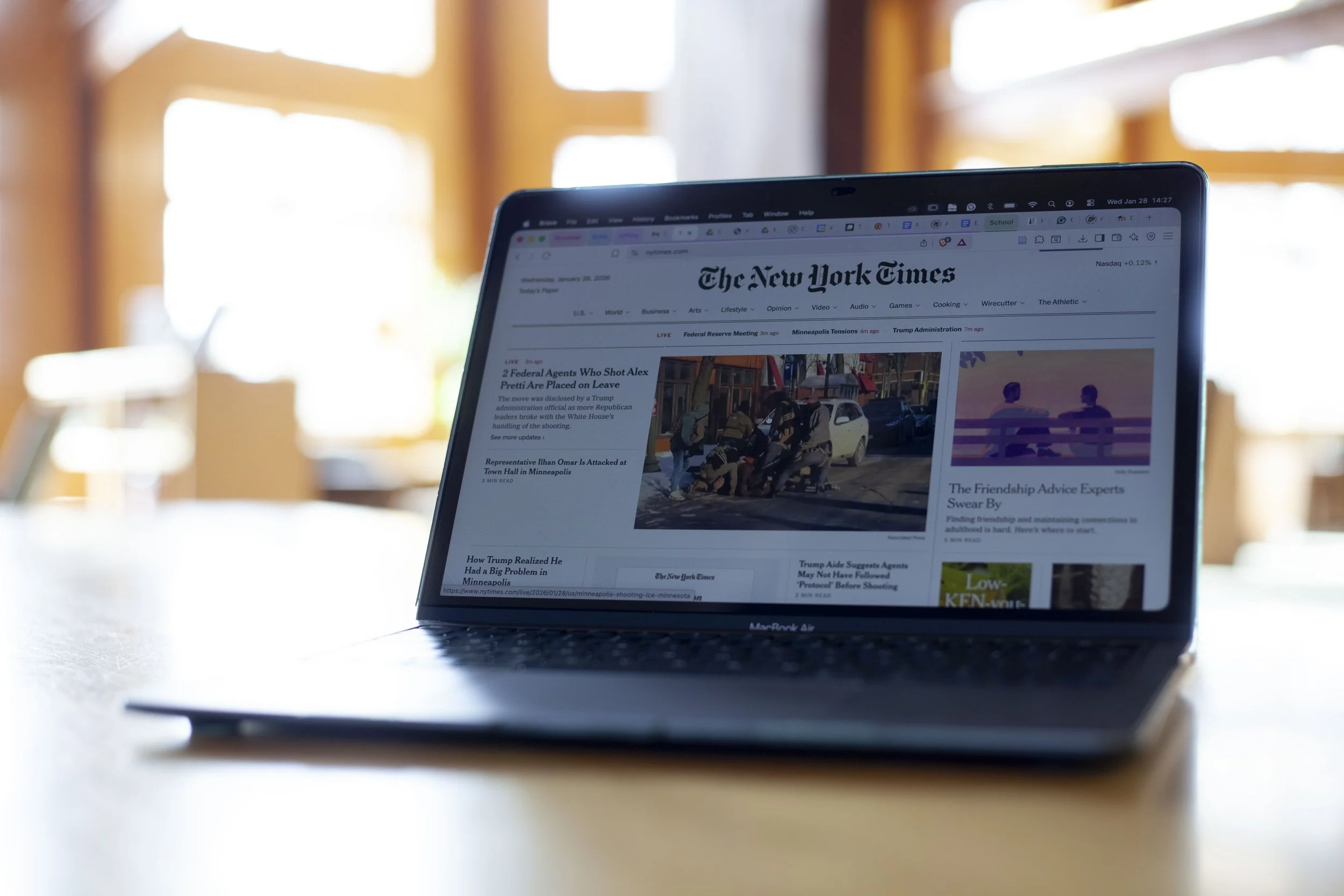
The home page of the New York Times displayed on a student’s laptop Pew Learning Center and Ellison Library at Warren Wilson College, on Jan 28, 2026 in Swannanoa, N.C. (Echo/Emma Taylor McCallum)
Misinformation. Retractions. Governmental obfuscation. Given the state of news media today, it is no wonder that U.S. consumers rated The Weather Channel, not The New York Times, NBC or CBS as the most trustworthy news source in 2025. Despite these flaws, millions of people still rely on these organizations to keep them informed of domestic and international events, still look to the journalists at these companies to report the facts around which they shape their lives. How can one critically engage with the sources to get the truth behind the reporting? Is it still possible to trust the news?
Beck Banks, assistant professor of communications at Warren Wilson College (WWC), understands the difficulties of critical news consumption, especially in a world where the abundance of news, especially delivered via social media, can leave consumers without a consensus on the facts of an issue.
“Most people are getting their news through social media, and that would be a great thing to stop doing quite as much, because algorithms give you things that are tailored to you,” Banks said. “That can be great for finding things that you're interested in, but it also really narrows your worldview.”
Banks combats this bias by practicing what they call “a daily news habit,” which consists of reviewing several trusted news sources. To them, this helps highlight the way each reporter chooses to frame a particular story, especially when those stories end up disagreeing.
“All this sounds overwhelming, but after you do it for a while, this is how that critical thinking starts to happen,” Banks said. “It's not going to happen overnight... It's a long-standing practice where you gain that kind of critical viewpoint and insight into how to understand the news that you're consuming.”
Beyond this framing, issues of trustworthiness can also arise in the evidence journalists and other news contributors use to back up specific claims. Jen Mozolic, professor of psychology and chair of the social work, expressive arts therapy and psychology department at WWC, stressed the need to contextualize any statistics and studies presented within a larger conversation about any particular issue.
“[Statistics are] just a piece of evidence that [have] to be taken in context, because it's just one little thing,” Mozolic said. “We all - researchers, everyone - probably hide behind this a little bit. It's like, ‘You don't get it, or you don't fully understand it, so I'm just going to use it to kind of hand wave and try to convince you that it is true’...Just because someone says it, and just because it looks important and shiny doesn't make it true.”
Mozolic, like Banks, advocates forming a regular practice of reading the news. She also tries to keep somewhat of a skeptical view of the stories she reads, especially when she finds herself taken in by a good narrative.
“I think that's something I'm always on the lookout for, like, is that too good to be true, too neat and simple?” Mozolic said. “I feel like when you learn something, it should complicate the issue, not resolve it. And so when I get to the end, and I'm like, ‘Wow, no way!’ I'm like, ‘Oh, wait, there's probably something that wasn't really fully explained or explored there.’”
Jack Igleman, journalist and instructor of economics at WWC, also has found himself maintaining a more critical position towards the news he reads. Despite worries that sometimes surface about bias and the increasing monetization of the news, Igleman still believes that journalism is capable of disseminating the truth. For him, the rise of people who choose to completely disengage from the news entirely because of their fears of journalistic reliability is a considerable concern.
“Reporting and journalism are so fundamentally important to unravel the truth,” Igleman said. “It worries me that people are like, ‘I don't trust it.’ I still do trust journalists, and I trust journalism for the most part. [People’s distrust of the news is] scary to me, for sure.”
In Igleman’s opinion, his job as a journalist is one defined by looking past easy explanations or simplifications of an issue to report to his readers in an unbiased way. He believes that journalists and media institutions can best build trust with their readership by trying to include as many perspectives as possible in their reporting, which leads to readers with different views feeling represented.
“I can see it from the other side too,” Igleman said. “I can totally understand why people are like, ‘The media is bullshit.’”
Like Igleman, Mozolic and Banks still maintain faith in the news despite their understanding of journalism’s potential blind spots. For them, a skeptical stance is simply one part of the important practice of engaging with the news, rooted in a belief that despite occasional errors and bias, the truth can still be known.
“I think at the end of the day, I want to know about people in the world and how they're doing, and [there’s] no better way to find that out than checking journalism and reading it on a regular basis,” Banks said. “This is how I perform my own civic duty. This is how I can stay in touch. This is how I will be activated...I think that the more you know on the journalism front, the more you know about the world around you, the more you can offer.”