

How Smart Are “Dumb” Phones?
Angel Alvarado | Feb. 10, 2026
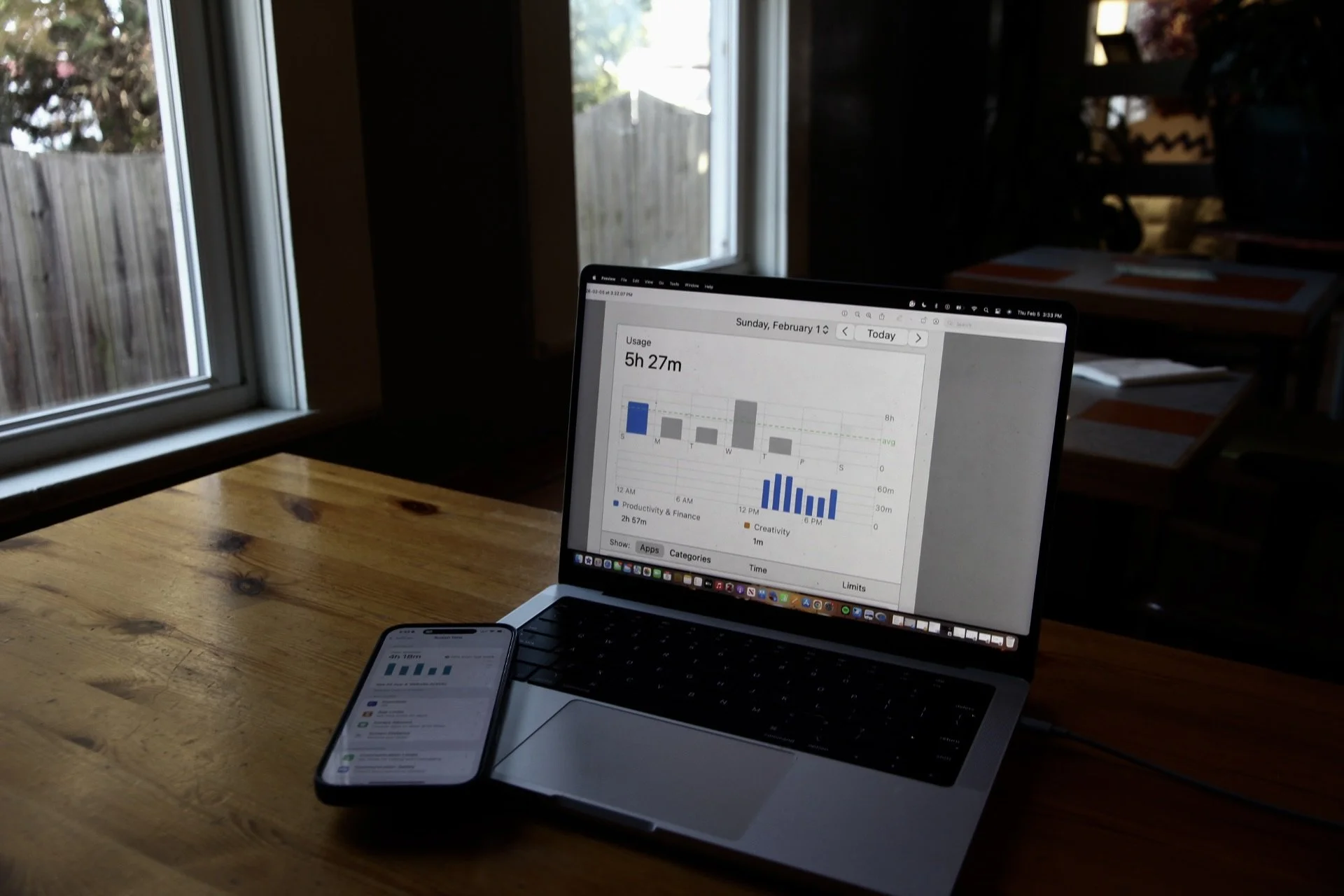
Image of a screentime report on a student’s laptop and cellphone at BattleCat Coffee Bar on Feb. 5, in Asheville N.C. (Echo/Vivian Bryan).
In this day and age, people are constantly surrounded by technology, ranging from phones to wild tech like Wi-Fi-enabled refrigerators and stovetops. It would be an understatement to say that society is heavily dependent on such devices. How can people live without them? Many people have intentionally switched back to older tech, like flip phones, that are less advanced and only support simple call and text features. Most modern flip phones do not have enough storage to download social media applications. These features make them more desirable for students who are looking to minimize their smartphone usage, whether for better focus, real-world connection or just need a digital cleanse to better their mental health.
Regardless of the motivation, there has been a rise in old or broken iPhones being exchanged for less advanced phones or “dumb” phones. On our campus, there are a few students who have switched to these devices.
Yso Ashworth, is a senior who used to spend 8-10 hours daily on their old Samsung flip 5 before switching to their new CAT S22 over a year and a half ago. Ashworth said they felt they were spending every free moment on TikTok, a popular social media app featuring an unlimited supply of short-form content. Ashworth shared that after their previous phone broke and was no longer covered under their protection plan, it was a better choice to get a cheaper and more durable phone.
Renee Lyman, a freshman, used to spend 5-6 hours daily on their iPhone before switching to a TCL flip 3 last October after their original phone broke.
Both students said they now have more time for hobbies and school work, using their regained time to reconnect with old interests and see friends. Additionally, they feel more productive when doing their assignments, completing them faster.
“I've spent more time outside,” Lyman said. “I think your phone provides a really easy filler of all of your free time, and it's designed to make you want to spend your free time looking at it, so just not even having that as an option makes you actually want to explore your creative passions.”
Ashworth mentioned that after spending a lot of time on TikTok, they felt uneasy interacting with others.
“I feel like if I have spent most of my day on social media or watching short-form videos, I feel less capable in social interactions, and I feel more anxious in general,” Ashworth said.
This raises the concern of how time spent on our devices keeps us from forming connections or building community. Jay Roberts, provost and dean of the faculty at Warren Wilson College (WWC) for the last six years, explained how he feels about the idea.
“I do think that there is a possibility that when we are so engaged with what's happening on our phones, we're not engaged with moving out of our spaces, whether they're dorm rooms or homes, and into public spaces of interaction,” Roberts said.
Roberts expressed his positive feelings about students starting to get “dumb” phones.
“I think we're gaining some clarity that just like any tool that comes into human existence, we start in a phase of naive optimism about the tool or the thing,” Roberts said. “And then we move into a phase where we kind of say, ‘Hmm, maybe we need some guardrails on this thing,’ and we have to learn how to do that.”
He also enthusiastically showed off his own phone, which was “dumbed down” using the Dumb Phone app, which allows a limited number of essential apps to be accessible and keeps the screen black and white to prevent dopamine stimulation. He shared that using the app allows him more control over how he uses his device.
“I'm not mindlessly getting my endorphins fed by some algorithms, I'm actually purposefully engaging the technique or the tool with my own sense of agency,” Roberts said.
With these new devices and apps making it a little easier to disconnect from the online world, another question emerges: if “dumb” device users feel disconnected, whether it be from pop culture references or the news that has now become popular and quicker to access on social media platforms.
Lyman does not feel like they are missing out on trends.
“There's no part of me that feels like I'm missing out,” Lyman said. “I hear people making references to like TikTok audios or Instagram reels, and I'll laugh because it's funny, but like every time, all I can think is, ‘Wow, I'm not missing anything.’”
Ashworth, when first switching to their ”dumb” phone, struggled to stay up to date on the news of the world.
Ultimately, there are disadvantages to having a “dumb” phone, but there are also many benefits. Lyman claimed that the advantages will outweigh any disadvantages and recommends that more people get “dumb” phones.
“I think everyone should get a flip phone at some point in their life, and I think Wilson is a really good place to do it, because you are in such a tight community where there is an opportunity for information to be shared constantly,” Lyman said. “I think it's unfortunate that in the society we live in right now, we are so dependent on technology that it is not possible.”
Perhaps more students will join the digital cleansing trend of “dumb” phones. Regardless, there are many benefits to spending less time on devices and spending more time interacting with one’s surroundings, especially at WWC, where one can always find events to attend or people to talk to.