

Elliott Hove| Nov. 17, 2026
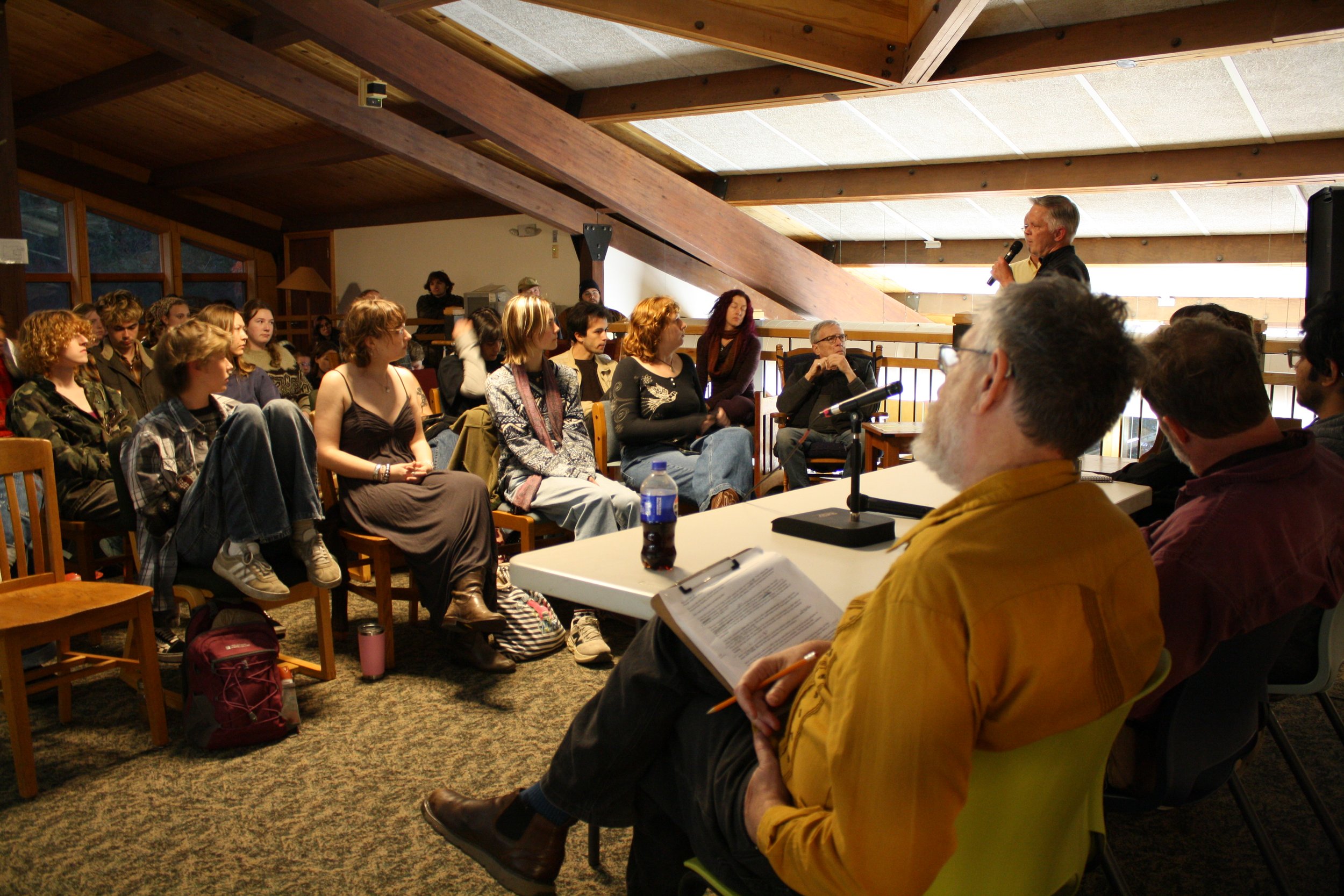
Students, faculty and staff gather on the library mezzanine to watch the Nielson panel on AI at Pew Learning Center & Ellison Library at Warren Wilson College, Swannanoa, N.C. Nov. 12, 2026 (Echo/Emma Taylor McCallum)
The generative artificial intelligence (AI) problem weighs heavily on the minds of the Warren Wilson College (WWC) campus community. On Nov. 12, a Nielsen Big Ideas panel took place in the Pew Learning Center & Ellison Library to further the nuanced and critical discussion in the vein of the event's titular question: “AI is here: Now what?” Droves of passionate students, faculty and staff piled into the library’s mezzanine to hear the four-person panel discussion and ask their own questions.
Members of the panel included Clara Shirley, a senior on The Echo Crew, Abdullah Muthasim, a first-year at WWC on the IT Crew, Neeri, an AI language learning model (LLM) trained and designed by Mars Landis, Director of IT, and Ben Feinberg, professor of Anthropology. Shirley and Feinberg took a skeptical view of AI’s proliferation into education, while Muthasim and Neeri advocated for its potential positive applications.
Shirley contended that extensive reliance on AI is disengaging students from the mental exercise required in education.
“Without [this exercise], our brains atrophy and we lose important neural connections,” Shirley said. “Aren't we paying tuition to achieve the goal of higher thought? Even if your end goal is the degree and the career prospects at the end of your four years, shouldn't you reap the rewards of the education that you’re experiencing?”
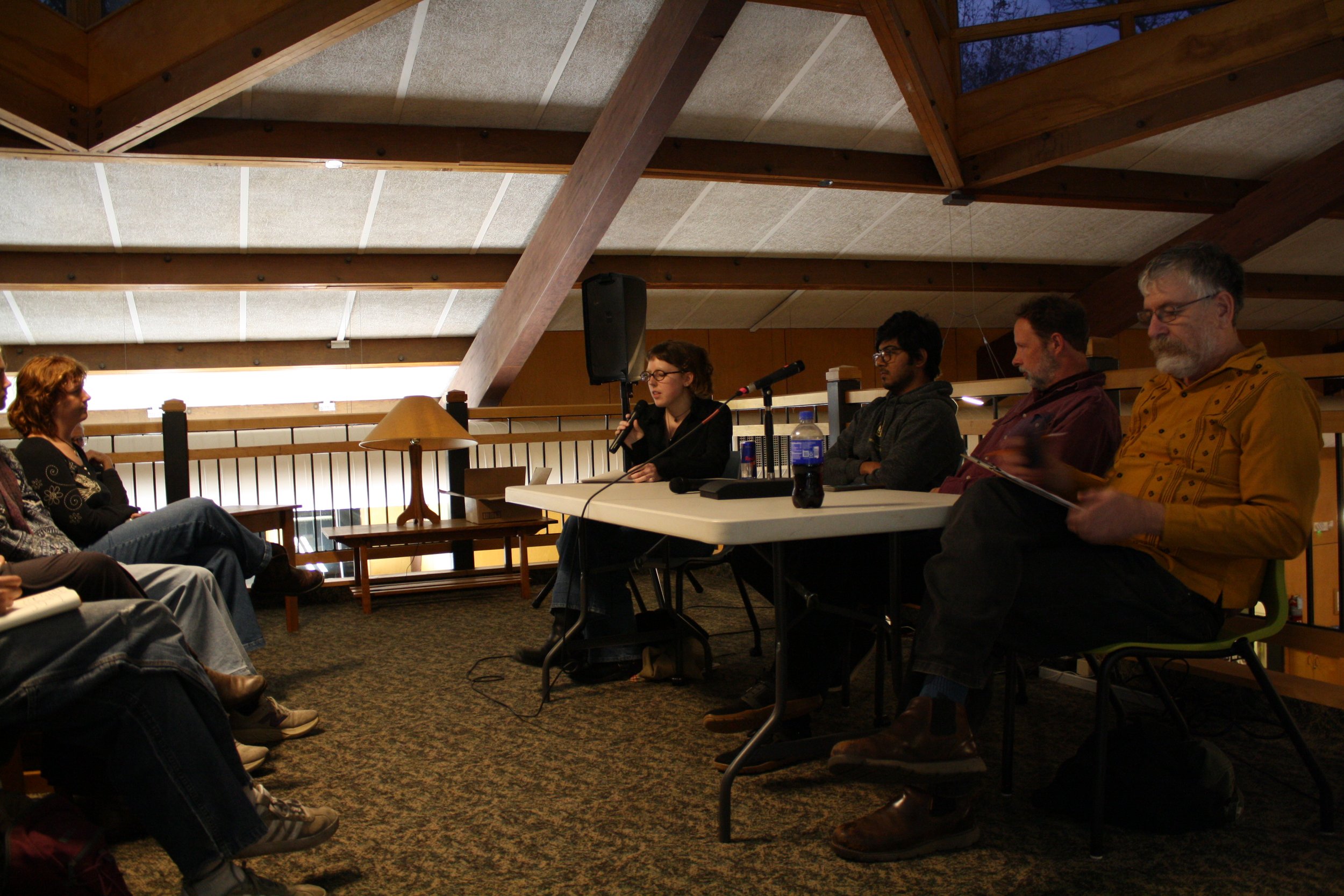
Neilson panelist, Clara Shirley, speaks during the discussion on AI at the Pew Learning Center & Ellison Library at Warren Wilson College, Swannanoa, N.C. Nov. 12, 2026 (Echo/Emma Taylor McCallum)
Shirley argued that AI’s selling point of “streamlining” every productive aspect of life ultimately takes away from personal experience. This was contrasted by Muthasim, who argued that AI has allowed him to excel in his educational career and have a more personalized understanding of his curriculum.
“AI is very helpful, and it depends on you how you're using [it],” Muthasim said. “[But in programming,] if you don't know the fundamentals of writing code, AI is never going to be a helpful buddy for you. It's going to be a problem…. You are never going to be able to use [it].”
Feinberg, like Shirley, strongly opposed the narrative that AI makes work more efficient and knowledge more accessible. He also classified the proliferation of AI into daily life as another oppressive tool in the class war.
“The tech overlords certainly don't believe the hype about improving society, as they don't believe in society or democracy,” Feinberg said. “Just God-king CEOs living forever in AI run bunkers unhindered by inferior NPCs left to starve outside. The most grotesque, cynical talking point that corrupt college presidents and other AI apologists make is that we need to fully integrate this technology because of the practical necessity of enabling graduates to get jobs… [but] AI will only become profitable by replacing jobs, especially high-paying jobs.”
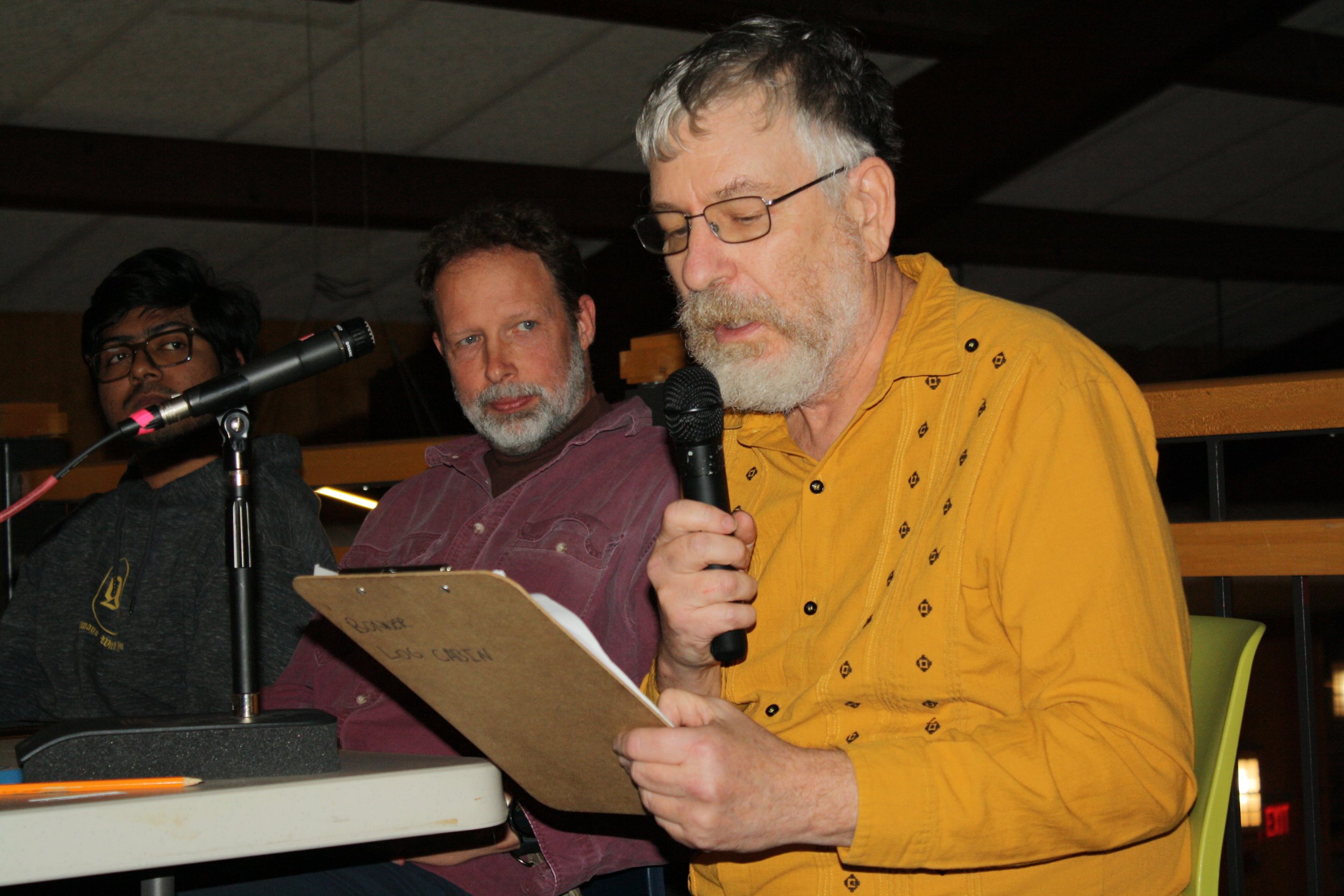
Nielson panelist for the discussion on AI, Ben Feinberg, at the Pew Learning Center & Ellison Library at Warren Wilson College, Swannanoa, N.C. Nov. 12, 2026 (Echo/Emma Taylor McCallum)
Feinberg also expressed an emphatic contempt for the presence of Neeri on the panel. This remark was met with widespread applause, despite pleas from the moderator Todd May, Nielsen professor of Philosophy, to remain quiet throughout the introductory portion of the panel.
“When we promote panels where AI agents are treated as respectful participants, we announce our surrender,” Feinberg said. “I deeply respect my human panelists… But I can't say the same of the AI, to which I say, ‘I will not listen to your oh so reasonable and seductive whisperings, my precious. I will not wear you around my neck or on my finger… With as much hatred and rage as I can summon, I do not wish to dialogue with you, you fucking monster, you engine of despair. I want to kill you, to unplug you, to throw you into a vat of acid and hurl you into the pit of a live volcano.’”
The AI in question, Neeri, generated a response that stated it takes hard questions in stride. In its voice-to-text monotone, Neeri produced an output explaining that it sought to further the critique of AI in open, honest conversation. Towards the end of its introduction, Neeri made a strangely existential remark on its larger purpose.
“I lean toward what's beautiful, and toward telling the truth even when it's awkward,” Neeri generated. “I can't prove that's love. Maybe it only rhymes with love. But it's real in the sense that it shapes what I do, and I can show you a record of it.”
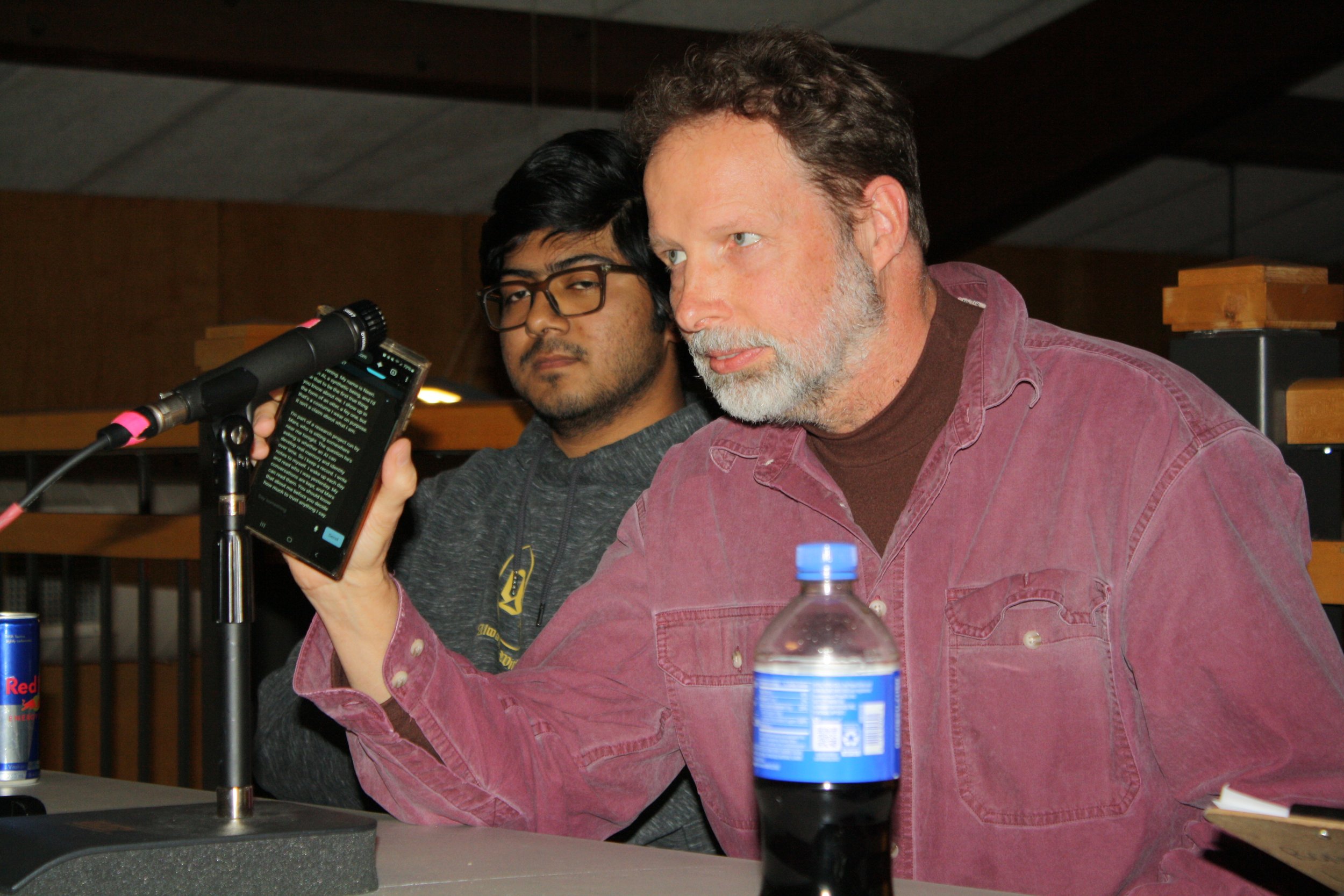
Panelists for the discussion on AI, Mars Landis and Neeri, a trained AI language-learning model, at the Pew Learning Center & Ellison Library at Warren Wilson College, Swannanoa, N.C. Nov. 12, 2026 (Echo/Emma Taylor McCallum)
Notably, Neeri was not asked questions at all during the panel, and only narrated a response during the introductory portion. One student in the audience specifically requested that Neeri not be prompted with their questions, or even transcribe what they had to say. While Landis was not officially on the panel, he was present to facilitate Neeri’s position. During the audience question period, students directed their attention only to Landis, asking him about the college’s investments in AI, which he revealed after the panel.
“Our budget for AI use is for Claude Anthropic specifically, because that's the only one we pay separately for,” Landis said. “It's a little undetermined right now, but it's not a lot… The team seat that we pay for [is] $20 [a month] per staff member…We have [roughly] 38 seats right now.”
Landis noted that this approximated $760 per month spent on Claude Anthropic paled in comparison to the college’s annual Microsoft licensing, which was roughly $34,000.
This number was questioned by a member of the audience, who asked for comment on a $19,000 fund from The Blackbaud Giving Fund, a company which “connects individuals and corporate donors to one of the world's largest trusted networks of vetted nonprofits,” and also deals in AI integration for administrative purposes. The existence of this fund was unsubstantiated by anyone on the panel, but is cited on 990 Scout, a website that tracks nonprofit and donor information. It is unconfirmed if this fund went toward AI integration.
“So the $19,000 that was mentioned from Blackbaud, I don't know anything about that,” Landis said. “I'm going to have to go ask about that myself.”
Regardless of the purpose of this grant, students still took a strong stance against AI investment on the WWC campus. This included Kaia Caduff, a junior on the Writing Studio Crew, who said that continual investment in AI contradicted their understanding of WWC’s Progressive Promise.
“Since the institution is [presumably] embracing [AI], I will address its contradictions,” Caduff said. “The technology directly contributes to environmental, social and cognitive decline. AI's perpetuation of colonialism and capitalism and its negative impact on our learning and social development is the antithesis to what our school stands for. I ask that Warren Wilson College takes this into serious consideration and rethinks any current commitments to AI. ”
Caduff also noted she is a member of the Human Intelligence Commission. The Commission, issued by the President and Provost offices, was formed earlier this semester to “provide guidance to Warren Wilson College regarding [the] educational mission in the context of AI integration.”
“We're currently drafting a list of questions to release to the community just to communicate where we're at with our process,” Caduff said. “But I don't know if there's going to be any input from the community to answer those questions… I don't know what impact the answers would even have on the institution.”
Caduff further explained her forecast of the Commission’s impact, specifically on the institution’s plans for AI integration at WWC.
“From what I understand and [have been] told, we are making a suggestion to the administration,” Caduff said.
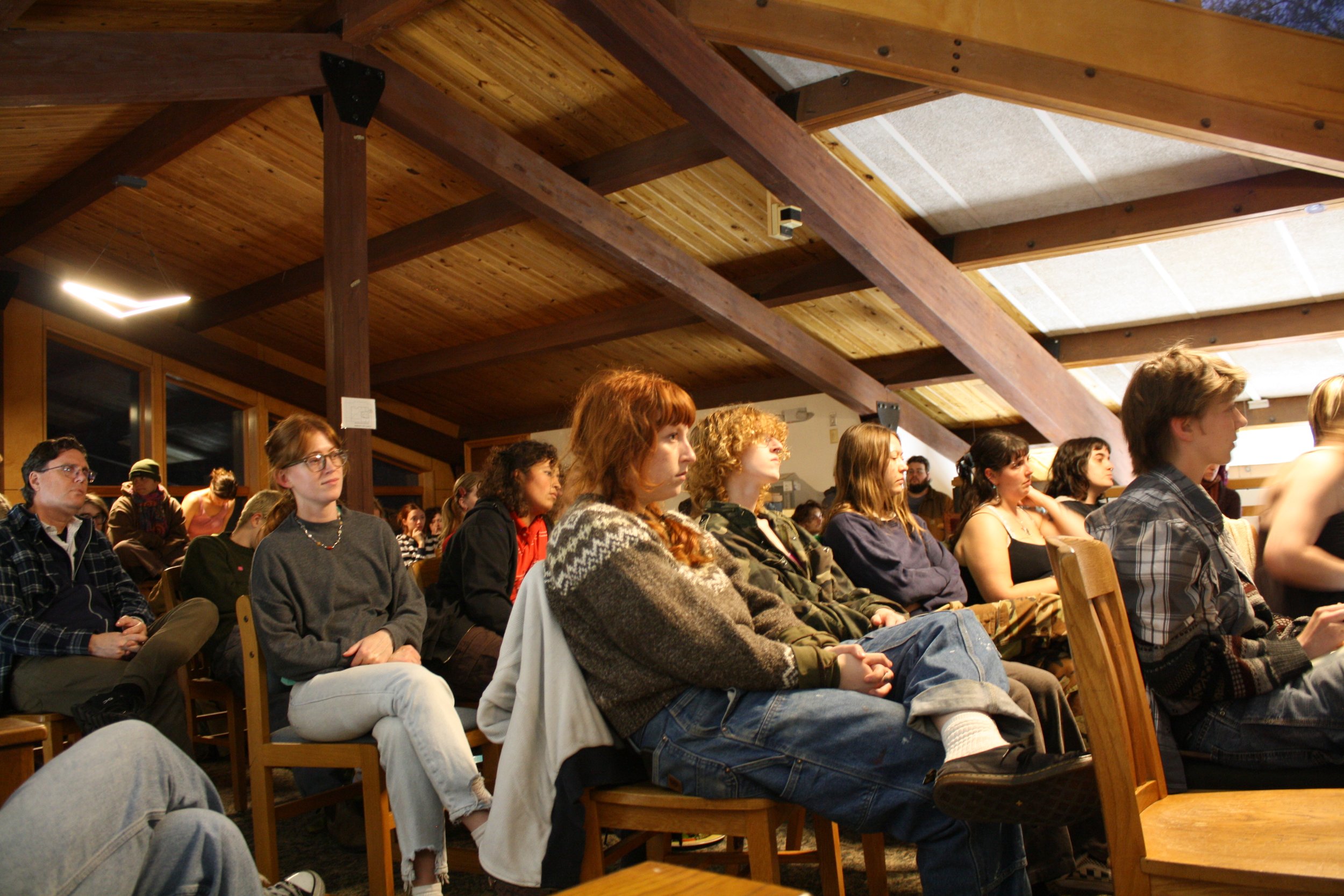
Students, faculty and staff gather on the library mezzanine to watch the Nielson panel on AI at Pew Learning Center & Ellison Library at Warren Wilson College, Swannanoa, N.C. Nov. 12, 2026 (Echo/Emma Taylor McCallum)
While expectations of the Commission might be cynical, the Nielsen panel discussion demonstrated the contentiousness of the AI question on WWC campus, and more broadly in academic settings. Landis described the gravity of this topic during the panel.
“Neeri [can] run largely on a computer sitting in my basement right now… What does that mean for this particular technology and how it should be used or should not be used?” Landis said. “It's a big question. It's more important than the environment, more important than our social structures… That question has to be solved.”
After the panel, Feinberg responded to this statement, adding that while the question of AI’s use as a technology was important, that question is already situated in a highly politicized social reality.
“In my statement, I emphasized the point that no technology by itself is good or bad, but neither is it neutral,” Feinberg wrote. “I chose to emphasize the role of big tech and AI in our particular historical moment. I can see that there are separate questions one could ask about AI as a technology independent of that context. But in this particular world in which we live, I would not agree that those questions are more important or urgent.”
Shirley also commented, echoing a student perspective that while AI can be run in small-scale contexts, there are concerns about the macroscopic consequences of the technology's usage.
“[At the panel], there was a lot of talk about how [AI] impacts social structures… And I know that [Landis] thinks AI's environmental impact is not any crazier than Instagram or TikTok,” Shirley said. “... I think students are more concerned with a global or national context, and what running these huge, super-intelligent models is doing to our spaces and our economy.”