

Politics 101: A College Kid’s Guide to Voting
Jesse Welty | Feb. 10, 2026
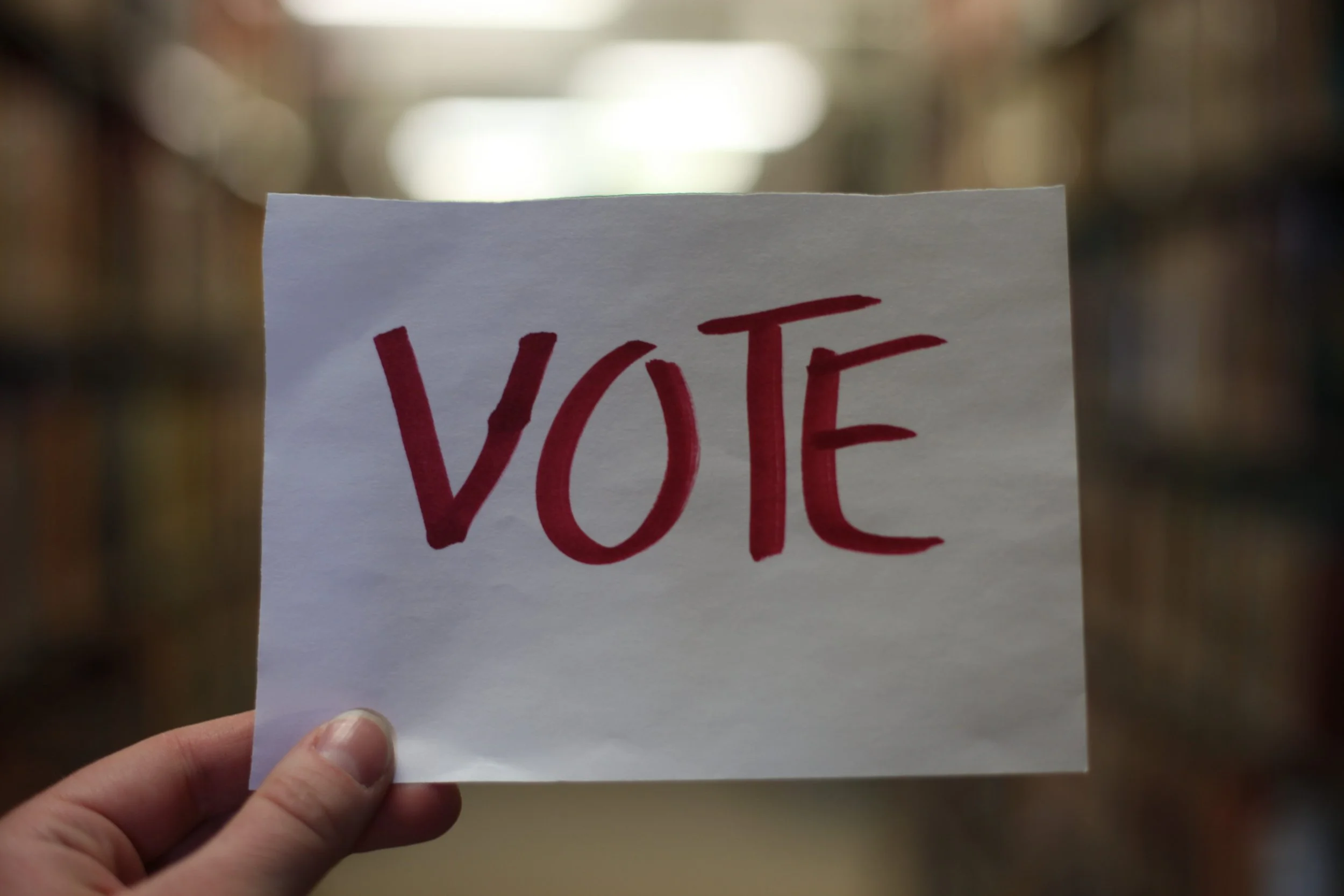
A paper with the word ‘vote’ written on it at Pew Learning Center and Ellison Library at Warren Wilson College, on Jan 28, 2026 in Swannanoa, N.C. (Echo/Emma Taylor McCallum)
With the North Carolina primary election just around the corner, it is crucial that eligible voters are aware of their rights and responsibilities within the electoral process. From marking down deadlines on the calendar to stepping into the voting booth, there are many steps to take in ensuring your vote is cast.
Registration is the first step. Although the pre-voter registration period has closed as of Feb. 6, 2026, same-day registration is still an option for college students with an in-county address. For Warren Wilson College (WWC) students, this would be the student's dorm address. This option, however, will only be available during the early-voting stage lasting from Thursday, Feb. 12, to 3 p.m. on Saturday, Feb. 28.
Students who plan on taking advantage of same-day registration must provide both photo I.D. and proof-of-residence at the time of voting. This may include a North Carolina driver’s license or any government or college-issued documents that contain the voter's current Buncombe County address. For WWC students, this may include your college I.D., or a screenshot of your campus mailing address as found under Campus Life on myWWC. For other approved documents, visit the North Carolina State Board of Elections (NCSBE) website.
If you are unsure about your current registration status, the NCSBE also provides a search tool that allows voters to review personal status, party affiliation, jurisdiction and voting locations. You may also use this tool to view sample ballots for any upcoming elections in your jurisdiction. If you have voted previously in elections outside of Buncombe County and plan on taking part in the North Carolina primary, make sure your affiliated county lines up with where you plan to vote. It is important to note that voters do not have to re-register before each election, so if you have already done so previously, simply use this tool to verify your information is correct before going to your polling location.
For students who are currently studying abroad, or will be outside of the registered voting location for the voting period, absentee ballots (or mail-in ballots) are also a viable option. This may also be an option for students who plan on voting in the primary election in their home-state outside of North Carolina, though deadlines will vary by state. For deadlines and more information on absentee voting in North Carolina, go here.
Once registration is completed, review the upcoming ballot to figure out which candidates you will be voting for. The easiest way to do so is to once again find your voter information through the NCBSE search tool and click on the sample ballot listed under the “Your Sample Ballot” tab.
The upcoming North Carolina primary election is a semi-closed primary. This means that both registered party affiliates (registered Democrats and Republicans), and unaffiliated voters are allowed to vote. In this system, a registered Democrat will only be allowed to vote in the Democratic primary ballot, and a registered Republican will only be allowed to vote in the Republican primary ballot. Unaffiliated voters will have the right to choose any one party's ballot, however all voters may only take part in one. Your available sample ballot(s) will reflect this affiliation.
The Democratic ballot will have six sections in which you may vote for a candidate: U.S. Senate, U.S. House of Representatives District 11, NC Court of Appeals Judge Seat 3, NC District Court Judge District 40 Seat 3, District Attorney District 40 and the Buncombe County Board of Commissions District 2.
The Republican ballot will have four: U.S. Senate, U.S. House of Representatives District 11, NC Court of Appeals Judge Seat 1 and the Buncombe County Sheriff.
Most candidates will have websites and/or statements detailing their proposed policies and personal ideals. While these direct resources may be very helpful in getting a general overview of candidates you may be interested in, it is important to do further research to receive a more unbiased account of how they put those ideals into action. Candidates will often be rather obtuse in political statements in an attempt to appeal to the most possible voters, however, knowing the specifics of how they will act as an elected official should be the driving force behind a voter’s decision.
Often, there will also be nonprofit organizations or political groups outside voting locations handing out physical ‘voter guides’ tailored to specific causes such as environmental initiatives or education. While these guides may prove helpful if you know you want to help aid those causes, it is also important to be able to make informed decisions based on personal knowledge of the individuals.
North Carolina’s primary election day will take place on March 3, 2026. The polls are typically open from 6:30 a.m. to 7:30 p.m., however, anybody in line by 7:30 p.m. will not be turned away and may still vote regardless of wait-times. While voters must go to their assigned polling location on this day (as found through the NCBSE search tool), early-voters may visit any early voting location in their county. Here are the early voting locations and associated hours for Buncombe County.
Most Buncombe County polling locations will utilize ES&S Express Vote technology, an on-screen ballot marking device found in each of the polling booths. When arriving at your voting location, poll-employees will help check you in and ensure all of your information is correct and up-to-date. You will be given a ballot-sheet and directed to a polling booth containing the ES&S Express Vote machine. The machine will provide step-by-step instructions on how to insert, cast and complete your ballot. To review more ahead of time, you may watch this video for further instruction on the digital process. Once completed, review and print the ballot with your selections. The location will also typically have a scanner located close by for you to insert your marked ballot into and officially cast your vote.
For voters that require further assistance due to disabilities, curbside voting is also an option. There will be markers outside the voting location guiding anyone requiring curbside assistance to the proper location.
After election day, you may check to see that your ballot was properly counted by reviewing the “Your Voter History” tab through the NCBSE search tool once the county completes post-election processes (which may take up to a few weeks).
While the United States’ democratic system continues to contradict itself through unequal voting access and unjust electoral practices, sometimes the best thing citizens can do to combat those attempts at undercutting civil power is to cast the vote regardless. Whether it be for your neighborhood elementary school or presidential authority, that one vote is an act of civil strength.