

Queers, Vampires and Villains: A Review of “The Lost Boys”
Emerson Hood | April 14, 2026
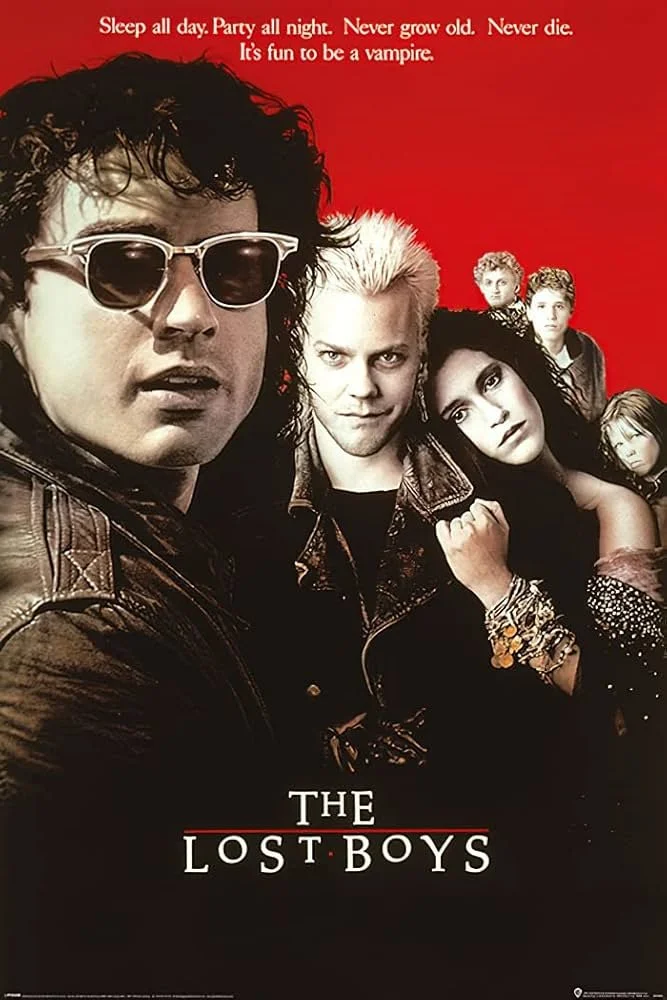
“The Lost Boys” poster.
This review contains spoilers
Every vampire story is about queerness. In film and fiction, the figure of the vampire as a predatory figure of uncertain sexuality preying upon the innocent has loomed large for centuries. “The Lost Boys”, in the tradition of “Dracula’s Daughter” and “The Vampire Lovers”, follows the classic formula: young ingenue, played here by actor Jason Patric, falls in with a member of the wrong crowd, who eventually reveals themself to be a member of the living dead. In “The Lost Boys”, the queer-coded vamp takes the form of bleach-blonde punk rocker David, played by Kiefer Sutherland, the leader of a group of equally outrageously dressed eternal teenagers. Patric stars alongside him as Michael Emerson, a disaffected young man who moves to Santa Carla alongside his brother Sam and his mother Lucy following a rough divorce.
The use of the gaze, a cinematic term meant to explore power dynamics in film based on who is being looked at and who is doing the looking, comes into play right from the start. On the brothers’ first night in Santa Carla, they attend a concert on the boardwalk where they are treated to the sight of a shirtless, oiled-up man playing the saxophone while gyrating across a stage. This scene, which has become infamous for its apparent lack of relevance to the rest of the plot, establishes a fascination with the male body. The camera ogles the Saxophone Man for an extended period of time, lingering on his tight purple leggings and glistening abs. Star, the female love interest, is not sexualized by the camera in nearly the same way. Indeed, it seems as if the movie is actively pushing Michael not to look at her. When she skips through the crowd, Sam physically turns Michael’s head away from her when he catches him staring. Later, when Michael searches for Star on the boardwalk, Sam complains incessantly, reinforcing the idea that his brother is making a mistake by pursuing heterosexuality. The plot serves to strengthen the narrative of Michael’s interest in girls as somehow dangerous, as his pursuit of Star is what places him in the gaze of David and his gang.
While Star is the bait that lures Michael into the lair of the Lost Boys, it becomes immediately apparent that David is the one he really belongs to. Although Star seems the quintessential 1980s love interest – beautiful, mysterious, low on lines but heavy on allure – she is quickly banished to the sidelines to make room for the homoerotic tension that seems to ooze from every scene featuring David and Michael. The interactions between the two are ripe with charged imagery: David gives Michael numerous objects to engage with orally, such as a joint and an ornate bottle containing vampire blood; he blows smoke directly at Michael’s mouth; he places his hands on him over and over again as he repeats that Michael is “one of them.” It is stressed, by both Sam and Star, that Michael is not a full vampire, but rather a half-vampire, a curious state of in-between occupied by those unfortunates who have tasted blood but not yet made their first kill. However, Michael never seems more at ease than when he is spending time in the vampires’ lair. At home with his family, he is surly and standoffish; with his new friends, he is light enough to fly, shown literally in a scene in which he and the other boys jump off a bridge together.
The Lost Boys electrify Michael’s ordinary world. As with most queer-coded villains, the predatory yet fabulous homosexuals who have stalked cinema screens from the inception of Hollywood, the camera simply loves them, as does the audience. The boys may be bloodthirsty, but they’re the ones who occupy the most space in our memory. The turning point comes at the end of the second act, when Michael witnesses the Lost Boys slaughter a group of surfers having a party on the beach. Up until this scene, much of the violence has been implied rather than explicitly shown. The earlier kills, those of the hapless security guard and the surfer couple Greg and Shelley, aim to leave the gore in the audience’s imagination, showing nothing more graphic than a close-up of a screaming face as the vampires descend. The beach massacre is a far different story. As the camera zips madly around the scene in a series of dizzying flashes, The Lost Boys savage the surfers, with blood splatter and fangs galore. Michael is horrified to witness the carnage on the beach. As he lies in the sand, David tells him what the audience already knows: that he is a vampire, like the rest of the Lost Boys, and he must drink blood in order to continue enjoying life as one of them. This revelation is extremely distressing for Michael, who has been clinging to his proximity to humanity. On the beach, he realizes the truth that he has spent the movie attempting to repress, much like a queer person attempting to repress their sexuality for fear of ostracization. But by the time he returns home, he is calm enough to realize his own place in the vampiric world of Santa Carla. He tells his brother, “I know who I am now, Sam.”
The movie ends with a grand showdown against the vampires, with the Lost Boys being picked off one by one by newfound vampire hunters. The death of David is not a joyful moment, no simple dispatching of the queer villain. The chorus of “Cry Little Sister,” the movie’s theme, plays as the lighting turns from hellish red to soft white, framing David’s face in an angelic halo. By contrast, Michael stands in the shadows, a look of horror and exhaustion on his face. His face, rather than being transformed back into its human state as he had hoped, remains vampirically distorted and monstrous, while David’s features seem younger in the light. Killing David doesn’t transform Michael back into a human, just as repressing one’s own sexuality will not keep it from existing. He has become truly lost, a vampire alone without even the company of the other vampires. In the end, there is only Michael, alone, staring shell-shocked and silent with the knowledge that he can never go back.
As much as it enriches the narrative, the queer subtext is not the only facet of “The Lost Boys” that makes it worth watching. The movie is a delight from every angle, possessing glorious 80s punk fashion, unexpectedly nuanced performances, and a killer soundtrack featuring music ranging in genre from snarling hard rock to gothic choir. Director Joel Schumacher was known for his visually stunning madcap style, and “The Lost Boys” fits well into that description. It is a film capable of being enjoyed by a vast array of people: horror enthusiasts, queers, vampire lovers, and those possessed by nostalgia for the late 1980s. If the almost forty years since its release prove anything, it is that “The Lost Boys” more than deserves its status as a cult classic.