
Lipstick, Lipgloss and More Female Artists, Too?
Ryleigh Johnson | March 24, 2026
If you were to visit the second floor of the Hirshhorn Museum in Washington, D.C., you would find a large abstract painting that looks like “The Birth of Venus”. Or, wait, it really looks like “The Swing”. Look again, and you might see some resemblance to “The Creation of Adam”. This work, titled “Lipstick, Lipgloss, Hickeys Too”, is a comment by artist Flora Yukhnovich on pop culture, art history and (of course) femininity. It’s also a testament to her love of the Rococo style and a reminder of its eventual fade from prominence in the art world due to its association with women.
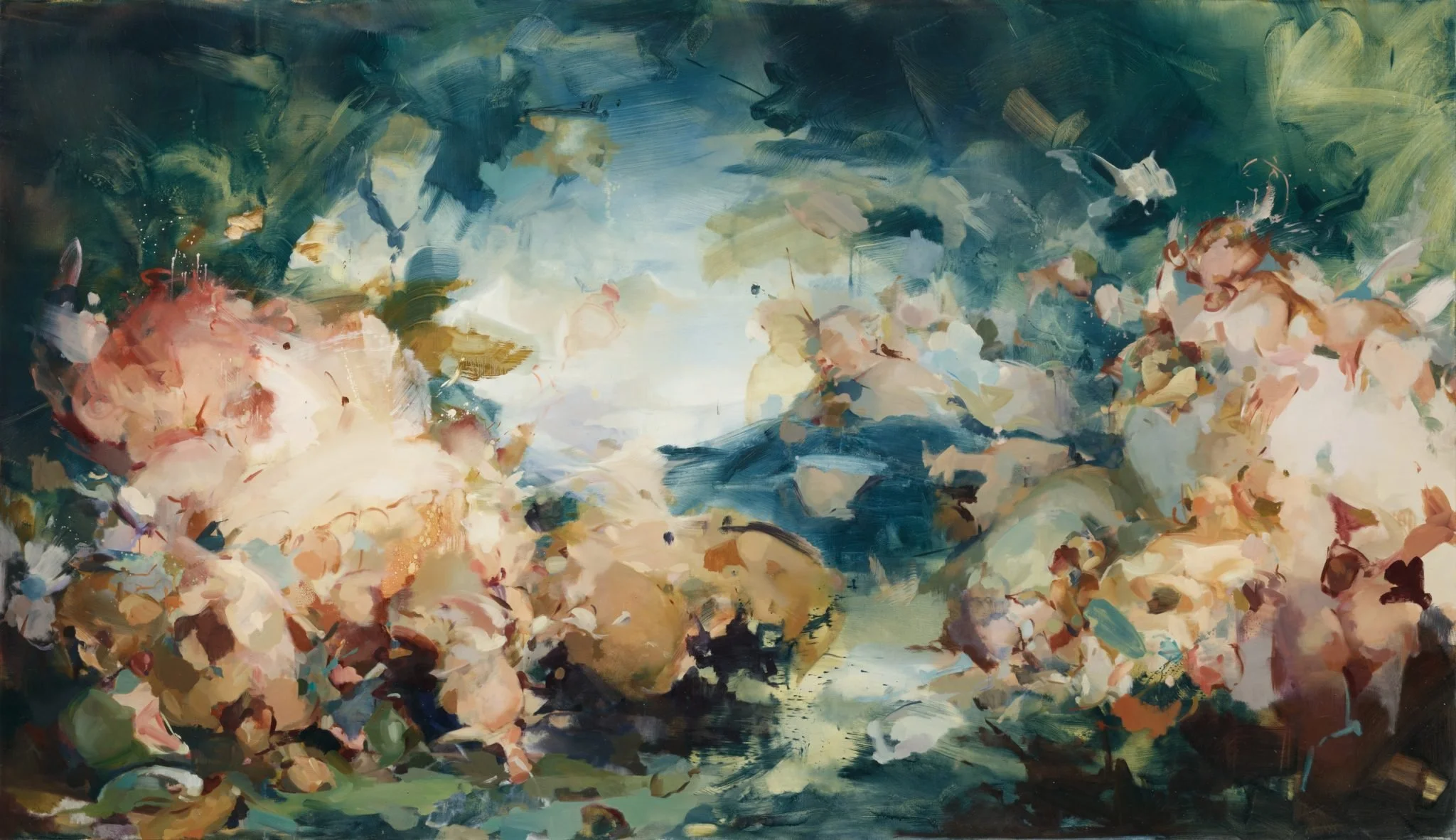
Image of the painting “Lipstick, Lipgloss, Hickeys Too”, created by artist Flora Yukhnovich. (Hirshhorn Museum and Sculpture Garden)
So why is “Lipstick, Lipgloss, Hickeys Too” in the Hirshhorn and not in the National Museum of Women in the Arts (NMWA), located just a few minutes away and explicitly focused on “right[ing] the balance for women and nonbinary artists and improv[ing] gender inequity in the art world”? The NMWA boasts a collection that prominently features female artists engaging with their status as “female artists,” and it seems that a work like Yukhonvich’s is perfectly aligned with this mission.
First, we might ask, what makes NMWA a “women’s” art museum? One could answer, simply, that it is a museum with art made by women. But, the experience of going to the NMWA suggests that a women’s art museum must, necessarily, have a deeper project in mind. Focused on advocacy and increasing the exposure of female artists, NMWA exists as a different kind of museum, raising explicitly political questions about how women are situated, both in the art world and in society as a whole.
In contrast, the Hirshhorn is a “leading voice for contemporary art and culture and provides a global platform for the art and artists of our time.” This art, though often political, exists in the context of a much more neutral space, one that purports its primary mission as “creat[ing] the space where people encounter the most important artists of the 21st century.” Yukhnovich is a prominent modern artist; that femaleness is a continual theme of her work could be seen as incidental. Her work, in this framing, belongs in the Hirshhorn because of her status as an important artist: gender neutral.
This work being housed in the Hirshhorn is positive in a variety of ways. Female artists, as NMWA points out on its website, are severely underrepresented in museums, with 87% of the work in major museum collections being by men. Those who may not intentionally seek out the work of female artists are offered the opportunity to “encounter,” and potentially be confronted by, the art these women create.
Another positive aspect of “Lipstick, Lipgloss, Hickeys Too”’s inclusion in the Hirshhorn is that it grants legitimacy to Yukhnovich and her artistic preoccupations. The Hirshhorn is a prestigious museum; having one’s work included in its collection confers a high status to both artist and creation. This status matters materially because it can lead to one’s art being valued at a higher price, directly impacting the feasibility of pursuing art as a career.
So why was it so sad to overhear a Hirshhorn tour guide explain Yukhnovich’s ethos and realize that there was a museum that shared this exact ethos that was not home to her work? For me, seeing “Lipstick, Lipgloss, Hickeys Too” inspired the same feelings of recognition that walking into NMWA did - one of the first photos I saw at NMWA actually made me laugh out loud. Yukhnovich’s painting echoed so many of the works I had seen in NMWA, with its refutation of the idea that women can’t be funny, can’t be sardonic, aren’t intelligent enough to understand their positionality and play with its implications. To me, Yukhnovich’s work felt spiritually connected to the work I found in NMWA, a long-lost sister.
There is so much joy in entering a museum and knowing every artist featured there is a woman, especially given the rarity of encountering female artists in nearly every other gallery. In a 2019 study of 26 prominent art museums, artnet found that only 11% of acquisitions were of work by female artists. There is no fear of this problem at NMWA, which exists as a celebratory space for female artists only. Yet this too can be troubling, primarily because the work NMWA contains deserves, just as much as the predominantly male painters featured in other, more prominent museums with larger budgets, to be seen. The depth and breadth of experience, the beauty that the female artists whose work resides at NMWA create, should be housed in places like the Hirshhorn more readily, providing provocation and sustenance to the visitors who may never choose on their own to engage with “female” art.
And so I am happy that NMWA exists, and I wish it didn’t have to. I wish there was more parity in the art world, that great female artists could be displayed as equals with their male peers. We don’t live in that world, not by a long shot, and so I am thankful for the NMWA, if only as a stopgap. In 2025, Yukhnovich told New York Times reporter Ted Loos that she thought of her work as “the idea of seeing something that you immediately recognize, but then you lose your footing continually.” It’s an apt description of her work, and maybe too of the role that specialized museums have to play in creating more equity within the art world.