

A Hampshire College Eulogy
Wyatt Layton | Sept. 8, 2026
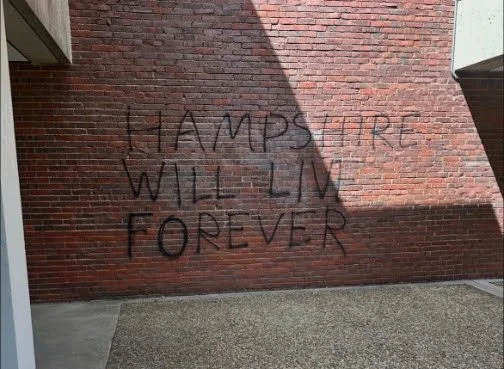
In the weeks after the announcement, graffiti began to pop up around Hampshire College Campus in Amherst, Mass., May 3, 202 (Echo News/Wyatt Layton)
After Hampshire College’s sudden closure, Warren Wilson College (WWC) took in 28 of its students. We are gathered here today to not only mourn, but also to celebrate the life of Hampshire College, which was an important and revolutionary institution, much like WWC.
While I did not believe I could go to college before finding Hampshire, my three years there made me truly believe in higher education.
The Day of the Closure
Amherst, Mass., April 14– At 8:15 a.m., Hampshire College staff, faculty, and student body of roughly 750 received an email alerting them that the spring 2026 semester would be the last fully-operating semester of the college. By December, operations would be shut down entirely.
Sure, Hampshire College had been struggling financially– the same way that all small liberal arts colleges have been. Within 20 minutes of walking on campus you’d be bound to hear at least one “our school is closing” joke. Yet, the news stunned all members of the Hampshire community. Schuyler Durand, a senior who worked in admissions at Hampshire, and is now on the WWC admissions crew, woke up about 45 minutes after the email was sent.
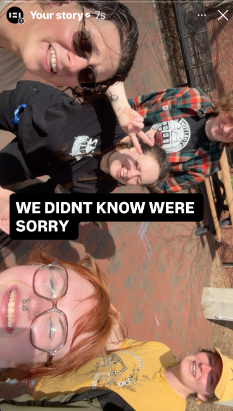
(From left to right) Ike Rubin, Peter Watko, Natasha Doherty, Schuyler Durand and Claire Guillemin smile for a selfie for the Hampshire College Instagram story, Amherst, Mass., Tuesday, April 14, 2026. (Echo News/Schuyler Durand)
“I woke up to a text notification from my girlfriend, who does not go to Hampshire but is friends with a bunch of Hampshire people, that said, ‘I'm so sorry about the email’,” Durand said. “I said, ‘What email?’ I pulled down my notifications, and I said, ‘Oh my God!’ And I read it, and I had a really out-of-body experience.”
A few hours after the closure announcement came out, another post graced the Hampshire College Instagram account:
“I was making a lot of Instagram reels, like recruitment videos to put onto the [Hampshire College] account, but I was not allowed to post things myself.” Durand said. “[On the day of the closure] I was with [several admissions counselors who are Hampshire alumni], and so we had all been walking around … I got a notification on my watch that we had posted an announcement to the Instagram, and I saw the graphic. ‘It's so ugly,’ is what I said, and I showed them the Instagram post that obviously was thrown together very quickly… It's so ugly, and we're all like, ‘Oh my God!’ sobbing over this Instagram announcement. So we take out my phone and we take a selfie of all of us in front of the bell, and I just write in all caps: we didn’t know, we’re sorry.”
The Hampshire Experience
Hampshire College operated differently from most institutions of higher education: instead of majors, there were concentrations. There were no required courses. Students chose two faculty members to act as their personal committee of advisors. Instead of typical classes, there were Divisions (Divs) I, II and III. Div I (freshman year) was focused on exploration, taking whatever classes interest the individual. Div II (sophomore/junior years) was about honing in on those interests, and involved completing one major project. Div III (senior year), was the culmination of a student’s studies. Only two classes-worth of credits were required to be taken that year, and the rest of a student's time was devoted to their capstone project. Projects ranged from biological art, to comedy specials, to in-depth studies on dolphin communication.
“Hampshire, by design, was a very outside-of-the-classroom-structured campus,” Durand said. “Some of my favorite aspects of campus life were just running into people doing really cool things like film projects and live music and murals and clubs and things campus-wide, like sword fighting, and just how well everyone knew each other, how dedicated to everyone else's work people were on campus.”

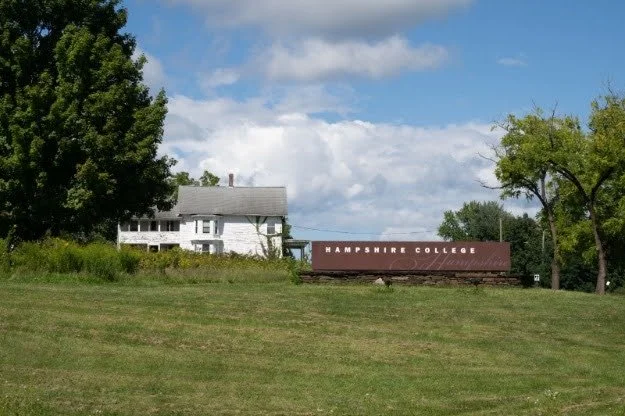
The Hampshire College Film Department was especially expansive, and housed analog film and photo equipment that is near-to-impossible to find in general, much less at a school of that size. Leo Vargha, another Hampshire transfer and a senior on the Holden Arts Crew, uses film as his primary medium.
“There was a really insane amount of equipment for 16 millimeter analog filmmaking,” Vargha said. “There are very, very few schools left that have that much equipment, even very, very fancy art schools like RISD (Rhode Island School of Design) do not have analog film equipment as substantial as Hampshire’s.”
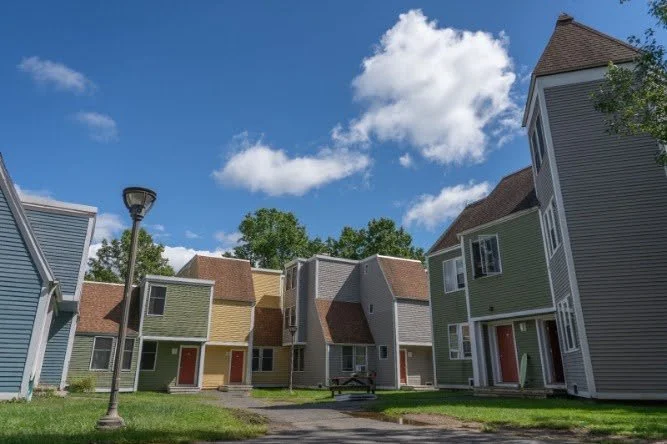
Enfield Mods, one of Hampshire’s on-campus townhouse-style housing options, Amherst, Mass., Sunday, Sept. 6, 2026. (Yuze Wu)
Hampshire College was built and designed to be woven into the Five College Consortium— a collective made up of Amherst College, UMass Amherst, Smith College, Mount Holyoke College and, for one more semester, Hampshire College. Durand was a teacher’s assistant for Hampshire Professor RL Goldberg’s Queer University Studies course in spring 2026. In this course, they discussed “The Making of a College,” Hampshire’s founding document, that describes its values, goals, and context in higher education as a whole.
“Hampshire's founding came with the founding of the consortium, and so suddenly all of the students within the five colleges could take classes at the other five schools,” Durand said. “Hampshire was designed so that students could utilize that system the most, and so we had an open curriculum.”
The Five College consortium was integral to the entire philosophy of Hampshire. Students could take any amount of classes at the other institutions (with an exception to stop any non-Amherst College student from taking more than two Amherst College classes). But even with 7,000 courses to choose from, many Hampshire students preferred Hampshire's classes.
“I would say generally my Hampshire classes that were lower level than my Five College classes were more rigorous, and difficult, and intensive, because I really wanted them to be,” Vargha said. “I made them difficult for myself because I wanted to challenge myself.”
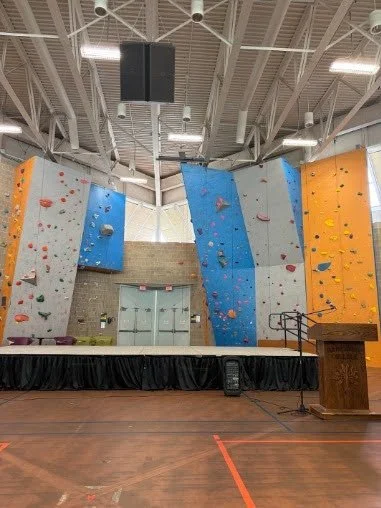
Hampshire College’s Robert Crown Center, moments before board president Jose Fuentes addressed the Hampshire community on the day of the closure announcement in Amherst, Mass., Tuesday, April 14, 2026. (Echo News/Wyatt Layton)
Hampshire’s curriculum allowed students to explore their interests, and gave them the freedom and space for those to develop into passions. It encouraged radical questioning, and the ability to think outside of the box. When it closes its doors in December, we will have lost one of the most fascinating experiments in higher education.
Looking Forward
As we settle into this new semester at WWC, keep in mind your Hampshire student classmates who are just beginning to relax after a very, very long five months. Hold your campus close, and please, hold off on the Wilson closing jokes for a little while – it’s funny until it's real, I fear.
To every fellow Hampshire transfer at Wilson, whether we’ve ever talked before or not, I appreciate seeing your familiar faces- it’s been one of the most comforting parts of such a chaotic and terrifying experience. I look forward to figuring out major requirements and non-single dorms with all of you.
To WWC students, thank you for welcoming us onto such a beautiful campus. All we ask for is a little grace:
“Forgive us if we're a little grumpy, but also everyone that ended up at Warren Wilson from Hampshire, I know all to be very sociable people,” Durand said. “We would love to tell you stories about Hampshire, and forgive us if we keep talking about it…there's going to be some growing pains, but I'm really happy to be here.”