

Why Do Some People Care About That Second Alex Pretti Video?
Ryleigh Johnson | Feb. 3, 2026

Still from video of Jan. 13, 2026 altercation between Alex Pretti and ICE agents in Minneapolis, Minn. (Max Shapiro)
On Jan. 24, 2026, videos of the shooting of protestor Alex Pretti by ICE agents in Minneapolis, Minn., spread across social media. Then, on Jan. 28, a digitally-based news site called The News Movement released a video of Pretti in an altercation with ICE agents 11 days before he died, spitting at agents and kicking out the taillight of a government vehicle. The interpretation of this second video has quickly become instrumentalized to serve preexisting narratives about Pretti’s death.
Two main views have emerged alongside the steady stream of videos capturing his killing. Pretti, an ICU nurse described by family as “a kindhearted soul who cared deeply for his family and friends and also the American veterans whom he cared for,” was accused of domestic terrorism by Secretary of Homeland Security Kristi Noem and called a “would-be assassin” by senior White House immigration policy advisor Stephen Miller.
Initially, outlets like The New York Times and The Guardian published stories contradicting Noem and Miller’s statements, as yet more videos of Pretti’s death and the testimony of eyewitnesses surfaced. While the White House demonized Pretti, it seemed that the majority of average citizens in the U.S. were horrified by what they saw as the murder of an innocent person who was simply filming an exchange between ICE and a civilian.
And then came the second Pretti video.
Some, sympathetic to Pretti and cognizant of the government’s active efforts to demonize him, were quick to speculate that the video may have been generated using artificial intelligence. Despite these claims, the video has been verified as genuine by multiple sources.
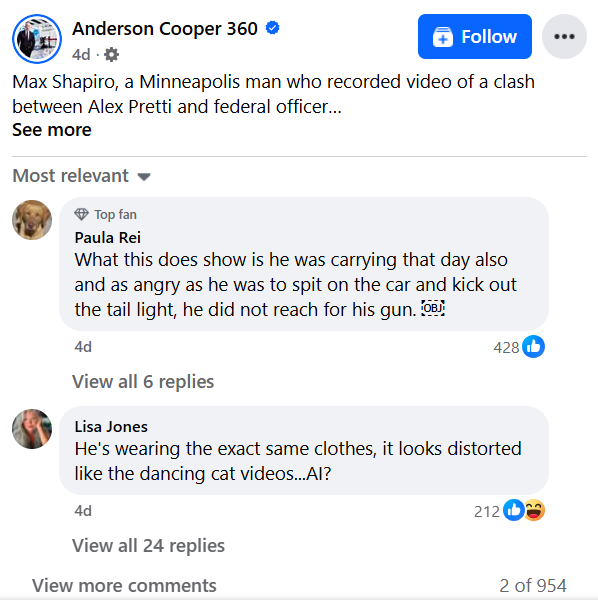
Image of Facebook comments accompanying a clip of the news program “Anderson Cooper 360” discussing the Jan. 13 video of Alex Pretti. (Ryleigh Johnson)
Trump quickly reposted the video on TruthSocial, declaring that, “Alex Pretti’s stock has gone way down” after calling Pretti an “agitator and, perhaps, insurrectionist” who damaged “a new and very expensive government vehicle.”
Soon, conservative outlets like The National Review were dissecting the second video and debating if its contents changed the context of the first.
“There are two arguments currently being advanced about Pretti,” Charles C. W. Cooke, a senior editor at The National Review, wrote. “The first is that he was unjustly killed. I agree with this. The second is that he was a saint. That is silly...The second video shows that this simply is not an accurate description of the man.”
Cooke insisted that he believes, “Pretti was shot dead in specific circumstances, not as a punishment for his cumulative actions or for being a hothead in general.” But, if Pretti’s shooting “stands alone”, why then does it matter if he is perceived as a good or bad person, a calm nature lover or a “hothead”?
Fundamentally, shootings like Pretti’s, or of Renee Good, another Minnesota protestor recently killed by ICE agents, become events around which narratives are created. It does matter to people whether or not Pretti, or Good, or the immigrants that Customs and Border Patrol posts videos of deporting are “good” or not, because to some people, goodness seems to be a requisite to possessing rights and protections under United States law.
This requisite for goodness helps to explain the impulse to view the second Pretti video as not truth in itself but rather as a tool, best used to strengthen preexisting narratives that fail to question their underlying assumptions. The truth is then bent to fit the stories we’re already telling ourselves. If you sympathize with Pretti, the video is fake. If you’re looking for a reason to justify his death, Pretti’s anger at ICE agents in the previous weeks is a great way to deter others who may feel tempted to express an uncharacteristic empathy for him.
This rigid binary obscures a deeper, darker reality of modern American political life: some people believe that a single frustrated outburst could justify the murder of a non-violent protestor by agents of the U.S. government. It is the same impulse that leads people to rationalize the deportation of “the bad immigrants” to the inhuman conditions of maximum security prisons like CECOT. Being less than perfect, having human emotions and making human mistakes should not make you less worthy of continuing to live. Until we can agree on that point, the incentives to view news like the second Pretti video as fodder for endless debates on who gets to be human and whose life does not matter will never end.