

Why Does Asheville's Black Population Keep Shrinking?
Catherine Lang | Dec. 9, 2025
For the last 40 years, Asheville’s Black population has been in decline.
On Nov. 12, the Asheville Watchdog sponsored a panel discussion at the Dr. Wesley Grant Southside Community Center to address the question: Why are so many Black people leaving Asheville? Leading up to the event, reporters Dan DeWitt, John Boyle and Sally Kestin interviewed dozens of current and former residents of the city to produce a four-part news series, “Losing Our Soul.”
In 1981, one in every five Asheville residents was Black. According to census data retrieved by the Watchdog, this ratio dropped to one in 13 by 2024.
Boyle led the panel and posed the first question of the evening to Dr. Dwight Mullen, former chair of the Asheville Community Reparations Commission and professor emeritus of political science at UNCA—Why should all residents of Asheville care about this?
“For those who do care, I think your attention has to be gained by looking at Black folk as the virus canaries…in that if Black folk can be priced out of the city, if we can be gentrified away for a variety of reasons, [then] we can be pushed for social-cultural reasons.” Dr. Mullen said. “If Asheville becomes a site of oligarchy rule—guess what's waiting for you?”
In 2017, Realtor.com ranked Asheville as the second fastest gentrifying city in the country. Beginning during the urban renewal projects of the 1960s, this process has transformed large sections of the historic Southside neighborhood into the current River Arts District. In 2025, the average rent for a studio apartment in Asheville was $1,559, 12% higher than in 2024. The average two-bedroom apartment costs $1,916 per month; however, the majority of listed apartments in Asheville are priced at over $2,100 per month.
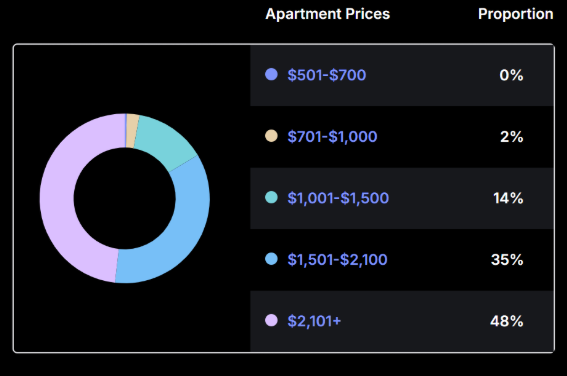
The current cost of renting in Asheville. (Rent.com)
Antanette Mosley, vice mayor of Asheville and a fifth-generation resident of the city, agreed with Dr. Mullen and said, “What happens in Black Asheville eventually works its way throughout the entire community.”
She noted how Save the Woods, a campaign to prevent the destruction of the UNCA urban forest, comes in the wake of a long history of deforestation. The most affected areas in the city were historic Black neighborhoods.
“The reason we can go ‘this is the last urban forest’ is because it's already been removed from the Black neighborhoods,” Mosley said.
Shenieka Smith, member of the Asheville City Council since 2017, responded to Boyle’s second question—What is the single biggest driver in the decline of Asheville's Black population and why?
“That reason is the Black Exodus,” Smith said. “That means it is a deliberate move from a bad condition or undesirable condition to pursue a ‘better’ condition. That ‘better’ could be better job opportunity, better living conditions, better housing opportunity or just a sense of place.”
Beginning in the 1970s, the U.S. has seen a migration of millions of Black Americans from northern regions into southern states. This phenomenon reversed the effects of the Great Migration of the early 20th century, in which Black families moved from the South to northern cities, including Detroit, Philadelphia, Chicago and New York, as more jobs became available during the first World War.
Along with Texas and Georgia, North Carolina is considered part of the “New South,” which has seen a steady increase in Black migrants, many of whom are well-educated working professionals. Cities like Charlotte and Raleigh are drawing new Black residents, including many of those who have left Asheville.
Atlanta, Georgia, has seen the largest in-moving Black population over the last 30 years, creating a significant political presence in the city as well as Fulton County.
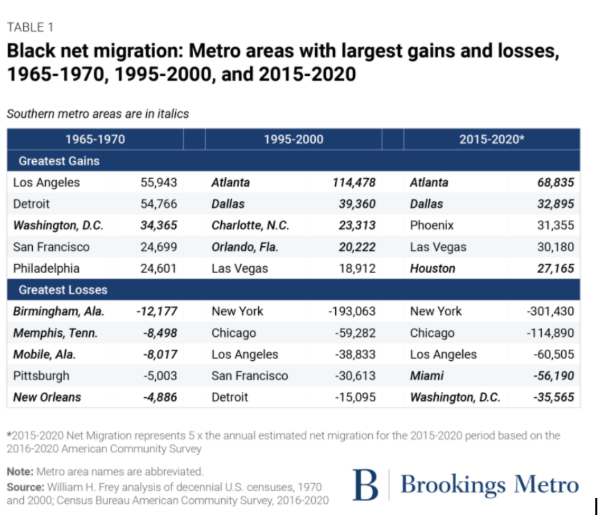
Highest rates of Black in-moving and out-moving by city. (Brookings Metro)
“If people are replanting themselves from the north back down south, and Asheville is well known as a tourist attraction, why not Asheville?” Smith said.
Community organizer Sekou Coleman, who currently represents the interests of historically Black neighborhoods through the Legacy Neighborhoods Coalition and Southside United Neighborhood Association, also attributed this to a lack of opportunity.
“People leave because of the limitations, both of professional as well as personal prospects for their futures,” Coleman said.
Priscilla Robinson, who has been researching the impacts of urban renewal on Asheville’s Black communities for over 15 years, spoke to her own experience of returning to Asheville as a working professional.
“[While living on the west coast, I] received all kind of promotions,” Robinson said. “Everybody just blended in, got along, and people cared, and people spoke and it wasn't a hold me back because I'm Black type of place. However, when I returned back to Asheville, it was like I came back in a time warp, and I knew that if I was to remain here, that I had to get busy.”
Despite facing social and professional limitations, Robinson found purpose in Asheville as a researcher and public educator.
“My son tells me, ‘Mama, why are you still in Asheville? You're holding yourself back,’” Robinson said. “But if I leave, then I feel like I will be cutting off any changes for my grandchildren, for generations to come, [for] generational wealth. So many other things have already been cut off, so I'm here to correct that.”
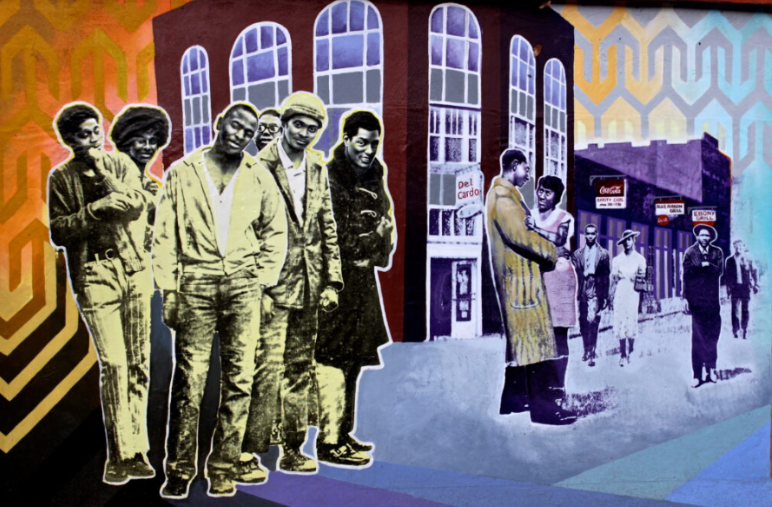
Panel of a mural in Triangle Park depicting several well-loved businesses during the heyday of the Block, Asheville’s Black business district. Painted by Molly Must. (Denise Carbonell)
Robinson also highlighted the gap in educational opportunities. In Asheville City Schools, standardized tests issued at the end of the 2021-22 school year revealed that 13% of Black students between third and eighth grade were considered proficient in reading, compared to 75% of white students. In the same grades, only 11% of Black students were considered proficient in math, compared to 66% of white students.
During urban renewal, the city lost many of its Black schoolteachers, who were more equipped to meet the needs of the Black students who were struggling in class. Stevens Lee, once a nationally recognized Black high school, was deconstructed. Today, Peak Academy seeks to uplift underserved children, though as Dr. Mullen pointed out, its facilities cannot accommodate the need for its services.
Smith recalled her own mother telling her to “leave and don't come back” after her high school graduation. Though for many residents, particularly older generations, leaving is not an option.
“I wonder how many more would leave if they could afford to leave,” Smith said. “And if that affordability is not financial, if they didn't have aging parents, or if they didn't feel a deep sense of responsibility.”
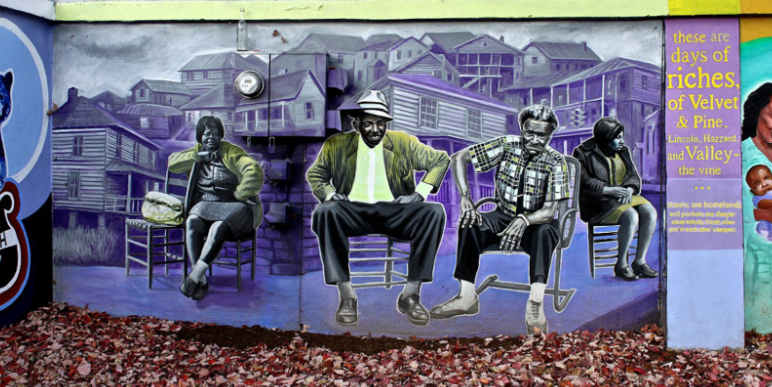
Panel of Triangle Park mural by Molly Must. (City of Asheville)
The uprooting of Black communities through urban renewal, gentrification of legacy neighborhoods, limited professional opportunities and the city’s high cost of living have built an Asheville that better serves its tourists, white retirees and remote workers than its generational Black residents.
Addressing the many non-Black audience members, Mosley said, “Get to know the Black neighborhoods and support them when you don't think you need to support them. Your life will be better [for it].”
Facilitating community discussions is one step toward bridging the gap between Black and white experiences in Asheville. Through online reservations, the panel’s venue reached in-person capacity several days before the event. Seventy-four people attended virtually through the Watchdog’s Facebook live stream.
“Asheville can make it happen when we understand what we want to do,” Smith said.