What's on the Ballot for Buncombe County Voters in 2026?
Elliot Hove & Ryleigh Johnson | Oct. 20, 2026
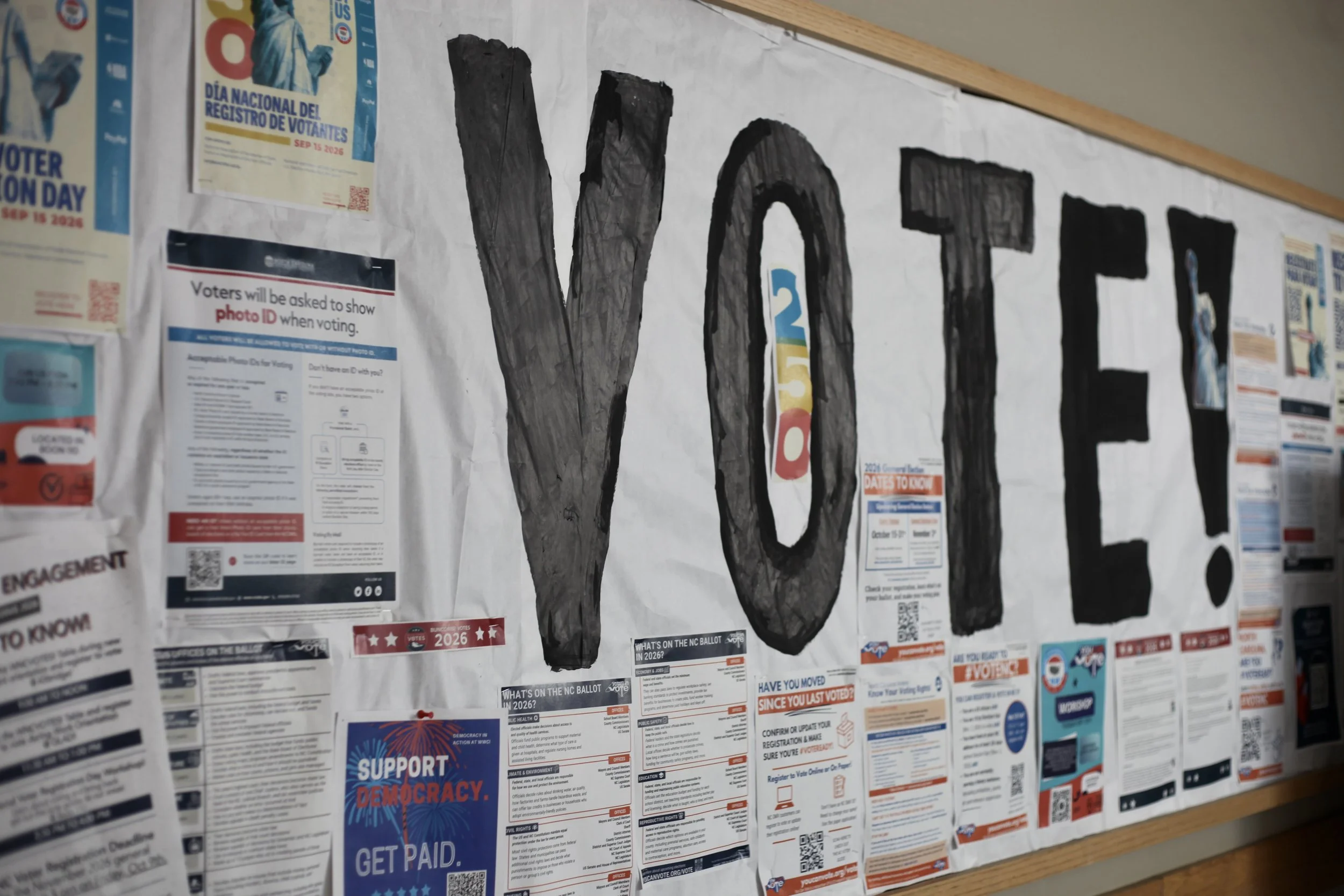
A bulletin board displaying voting information and reading “Vote!” in large letters hangs covers a wall in the Gladfelter Dining Hall on the Warren Wilson College Campus in Swannanoa, N.C. on Sept. 5, 2026. (Echo/Vivian Bryan)
Early voting in North Carolina for the 2026 midterm elections began on Oct. 15. Here is a breakdown of all of the issues and candidates Buncombe County voters will find on their ballot when they head to the polls. Voters can see a Buncombe County sample ballot here.
State-Level Offices
Senate
This November, N.C. will elect one senator. The candidates are:
Roy Cooper, Democrat (D)
Michael Whatley, Republican (R)
Shannon W. Bray, Libertarian (L)
Michael Dublin, Green Party
Cooper, former state governor, is running on a platform of lowering tariffs. He is favored to win the race. Whatley, former chair of the Republican National Committee, is campaigning on public safety and has publicly aligned himself with current U.S. President Donald Trump.
Shannon Bray, a Navy veteran, has built a stance on “ending corporate handouts”, reduced taxes, and cutting the rate of inflation. Dublin, a retired teacher, is campaigning on a Green New Deal for NC that could bring in both renewable energy and jobs to the state. He also seeks to oppose the building of data centers and new oil drilling facilities.
Political analysts have categorized this as a race to watch, as it has the potential to influence the partisan balance in the U.S. Senate.
House of Representatives, District 11 (NC-11)
N.C. will vote to elect a representative from NC-11. The candidates are:
Jamie Ager (D)
Jennifer Balkcom (R)
Travis Groo (L)
Balkcom replaced incumbent Chuck Edwards on the ballot after The U.S. House Ethics Committee censured Edwards following a report that found he engaged in “persistent unprofessional and inappropriate conduct” towards female staffers. While NC-11 has not elected a Democrat since 2010, some analysts have speculated that Edwards’ departure from the race and the popularity of Ager could flip the seat.
Ager is running on a platform of ensuring continued aid and recovery following Hurricane Helene, making healthcare affordable and reforming the U.S. immigration system. His full platform is available here. Balkcom has identified public safety and agriculture as two essential issues for her campaign, along with sharing her passion for “Ensuring fairness and equal opportunity for women and girls in athletic competition.”
Groo is running on the platform that all taxes on income, food and grocery should be abolished, and public office holders should be elected by a majority of all voters without the need for a costly runoff election.
This is another race considered high-stakes, as it also has the potential to influence the partisan balance in the U.S. House of Representatives.
NC Supreme Court Associate Justice Seat 1
The N.C. Supreme Court is the state’s highest court, adjudicating cases from all other state-level courts on issues from education to gerrymandering. The court has a Republican majority, 5-2. The candidates are:
Anita Earls (D)
Sarah Stevens (R)
Earls is the incumbent running on a platform that emphasizes her experience as a civil rights lawyer. She opposes the overturning of Roe v. Wade, criticized federal immigration enforcement and supported decriminalizing simple marijuana possession. Stevens, a former member of the N.C. House of Representatives, has stated that she opposes Earls because “my opponent has twice ruled against the Constitution on issues of voter identification and redistricting. She has also rewritten the law and disturbed 90 years of common law.” Stevens voted for a bill that increased requirements of local law enforcement in N.C. to comply with Immigration and Customs Enforcement (ICE). She also voted to prohibit transgender girls from participating in school sports.
Voters can watch a conversation with Earls and Stevens here.
NC Court of Appeals Seat 1
The N.C. Court of Appeals is the “state's intermediate appellate court that reviews the proceedings that occurred in trial courts for errors of law or legal procedure,” deciding if there were “errors of law or legal procedure” in a case. Three of the court’s 15 seats are up for election in November. Republicans hold a majority in the Court of Appeals, 12-3. For seat 1, the candidates are:
Michael C. Byrne (R)
John S. Arrowood (D)
Arrowood is the incumbent, having served on the Court of Appeals since 2017. He is the first openly LGBTQ+ judge elected to the Court of Appeals. Byrne, a former administrative judge, describes himself as a “conservative judge” who will protect the “rights of all parties.”
Voters can watch a conversation with Byrne and Arrowood here.
NC Court of Appeals Seat 2
The candidates for seat 2 are:
George Cooper Bell (R)
Tobias (Toby) Hampson (D)
Hampson is the incumbent, having served on the Court of Appeals since 2019. Bell has served as an N.C. Superior Court Judge since 2019 and his campaign for the Court of Appeals is focused on “judicial restraint, public safety and constitutional interpretation.”
Voters can watch a conversation with Bell and Hampson here.
NC Court of Appeals Seat 3
The candidates for seat 3 are:
Craig Collins (R)
Christine Marie Walczyk (D)
Collins currently serves as an N.C. Superior Court judge who has promised to “not allow political agendas to influence the law that’s already established.” Walczyk is a District Court Judge who has emphasized the need for flexibility when applying older laws to present, real-world situations.
Voters can watch a conversation with Collins and Walczyk here.
State Constitutional Amendments
There are three amendments to the N.C. State Constitution on the ballot this fall. They are listed as follows:
Constitutional amendment to require all voters, not just those presenting to vote in person, to present photo identification before voting.
Constitutional amendment to keep the State income tax rate from being raised higher than three and one-half percent (3.5%).
Constitutional amendment requiring limits on property tax increases by local governments.
While North Carolina already has a voter ID requirement, this amendment would establish in the state constitution a need for photo ID, even for mail-in ballots. Proponents of the amendment say it increases voter security and validity, while opponents argue that it adds another hurdle to the voting process in order to dissuade mail-in ballots or uncertain voters.
The second amendment, which proposes lowering the cap on income taxes from 7% to 3.5%, originates from a Republican push to gradually lower the income tax, especially the corporate income tax (on track to be eliminated by 2030).
Many have criticized the wording of these constitutional amendments as intentionally vague, such as Victoria Creamer, principal of Creekside Elementary School. She highlighted that the latter two amendments could spell out major cuts in funding for public education, which greatly depends on income tax for its funding. Opponents of the amendment also argue that this will negatively impact social services, state universities, and state infrastructure projects.
Buncombe County Specific Issues
North Carolina State Senate District 49
The N.C. State Senate, in conjunction with the N.C. House of Representatives, creates laws and sets the state budget. The Senate has a Republican majority, 30-20. The candidates are:
CJ Domingo (R)
Julie Mayfield (D)
Mayfield is the incumbent, who has advocated for LGBTQ+ rights, gun control and “clean renewable energy.” She is also the co-founder of Reclaim Healthcare WNC, a coalition focused on shifting possession of Mission Hospital from HCA Healthcare to a non-profit owner. Domingo, who has never held political office, is focused on rebuilding infrastructure after Hurricane Helene, incentivizing employers to prompt economic growth and supporting social services.
North Carolina House of Representatives District 115
The N.C. State House of Representatives is the other body that makes up the state’s legislative congress. District 115 includes large parts of Buncombe county, as well as Warren Wilson College. The candidates for district officeholder are:
Anthony Penland (R)
Lindsey Prather (D)
Both candidates agree on a number of issues, including securing more state funding for Hurricane Helene relief. Prather, a former teacher in Buncombe county seeking her third term as Representative in House District 115, has built a campaign focused more on affordable housing, child tax credits and care subsidies, and a $15/hr minimum wage.
Penland, the former Buncombe county commissioner and Swannanoa fire chief, differs from Prather on two main issues: a proposed constitutional amendment to limit the ability of local governments in N.C. to establish property taxes and the state’s school voucher program (often referred to as “school choice”) that allows state tax dollars to act as scholarships subsidizing students’ private education. Penland has said he will vote for the constitutional amendment, which Prather opposes on the grounds that it shifts control out of local governments. He also promised to support the school voucher system, though he has stated that there should be limits on the amount students can receive. Prather has voiced her opposition to the voucher system, arguing that it unfairly takes money from public schools.
Buncombe County Board of Commissioners District 2
The Buncombe County Board of Commissioners acts as the county’s governing body, deciding tax rates and the county’s annual budget, along with managing land and county services. The candidates for District 2 are:
Greg Parks (R)
Lonnie Israel (D)
Both Parks and Israel have emphasized the need for accountability in how the Board manages the county’s budget. Israel, former treasurer of the Upper Hominy Fire Department, seeks to support education, agriculture and continued recovery after Hurricane Helene in Buncombe County. He has also identified overcrowding in the Buncombe County Detention Center as an issue he would like to address. Parks is seeking to lower taxes and back “a tax system focused on economic growth, individual liberty and efficiency.” He also says he will back agricultural programs like 4-H and FFA and address “the panhandling, drug use and high crime rates” in the county.
Buncombe County Sheriff
The Buncombe County Sheriff oversees the county’s sheriff’s department, a law enforcement agency that serves court documents, operates the Buncombe County Detention Center and provides security for the county courthouse. The candidates for this office are:
Gary Parris (R)
Quentin Miller (D)
Miller is the incumbent, elected in 2018 as Buncombe County’s first African American sheriff. Both Parris and Miller have stated that they will not engage in immigration enforcement on behalf of U.S. Immigration and Customs Enforcement (ICE). Parris identified drug activity as his biggest concern, and has also committed to “restructure facilities, policies and staff” at the Buncombe County Detention Center. Between 2008 and 2018, the detention center had the second highest jail fatality rate in the state.
Miller’s biggest concern in the county is gun violence. He supports increasing mental health resources for law enforcement, along with increasing pay to aid in retention of officers. Miller cited his implementation of medication-assisted drug treatment, an expanded medical contract and the purchase of a scanner to help lessen the flow of drugs and other contraband into Buncombe County Detention Center as policies to lower the jail fatality rate.
Buncombe County Soil and Water Conservation District Supervisor
The Buncombe County Soil and Water Conservation District works to protect soil, water and other natural resources in the county. The board of supervisors that controls the district consists of five unpaid positions, two of which are open this election. Voters can choose two of the following candidates for this nonpartisan office:
Trent Duncan
Alan Ditmore
Anthony D. Cole
Sara Nichols
Cole and Nichols are incumbents, with Nichols acting as the current chair of the district board. Nichols, who has worked in local government in Western North Carolina for 20+ years, has promoted balance between meeting Buncombe County’s conservation goals and honoring the needs of the community. Cole, a farmer who researched soil management at N.C. State University, emphasized the importance of sustainably managing the county’s natural resources. While Trent Duncan’s name will be on the ballot, he informed the Mountain Xpress that he was formally withdrawing from the race on Sept. 8. Alan Ditmore is running “to advance abortion and contraception rights and funding,” arguing that abortion and contraceptives prevent soil and water pollution.
The 2026 Buncombe County Bond Referendum
Buncombe County voters will also be asked to weigh in on two potential county bonds. One bond would help to fund conservation efforts in the county and preserve open agricultural land, along with providing funds for the “repair and development of parks, greenways, trails, and other outdoor recreational opportunities.” The second bond aims to increase the amount of housing for low-moderate income Buncombe County residents.
Both bonds are “general obligation” bonds, which are a type of bond issued by a government that uses the government’s resources, like its ability to tax its resident, as a levy for the bond. General obligation bonds are often utilized by municipalities to fund large projects that the municipality may struggle to finance on its own. Buncombe County promises to repay its debt, in part, through its property tax on residents.
For the conservation bond, taxpayers would pay an additional $4.10 per $100,000 of property tax value per year. For the affordable housing bond, taxpayers would pay an additional $5.50 per $100,000 of property tax value per year.
To see an individualized sample ballot, check their polling place and verify their voter details, voters can visit the N.C. State Board of Elections website.