

Emma Taylor McCallum | Nov. 3, 2026
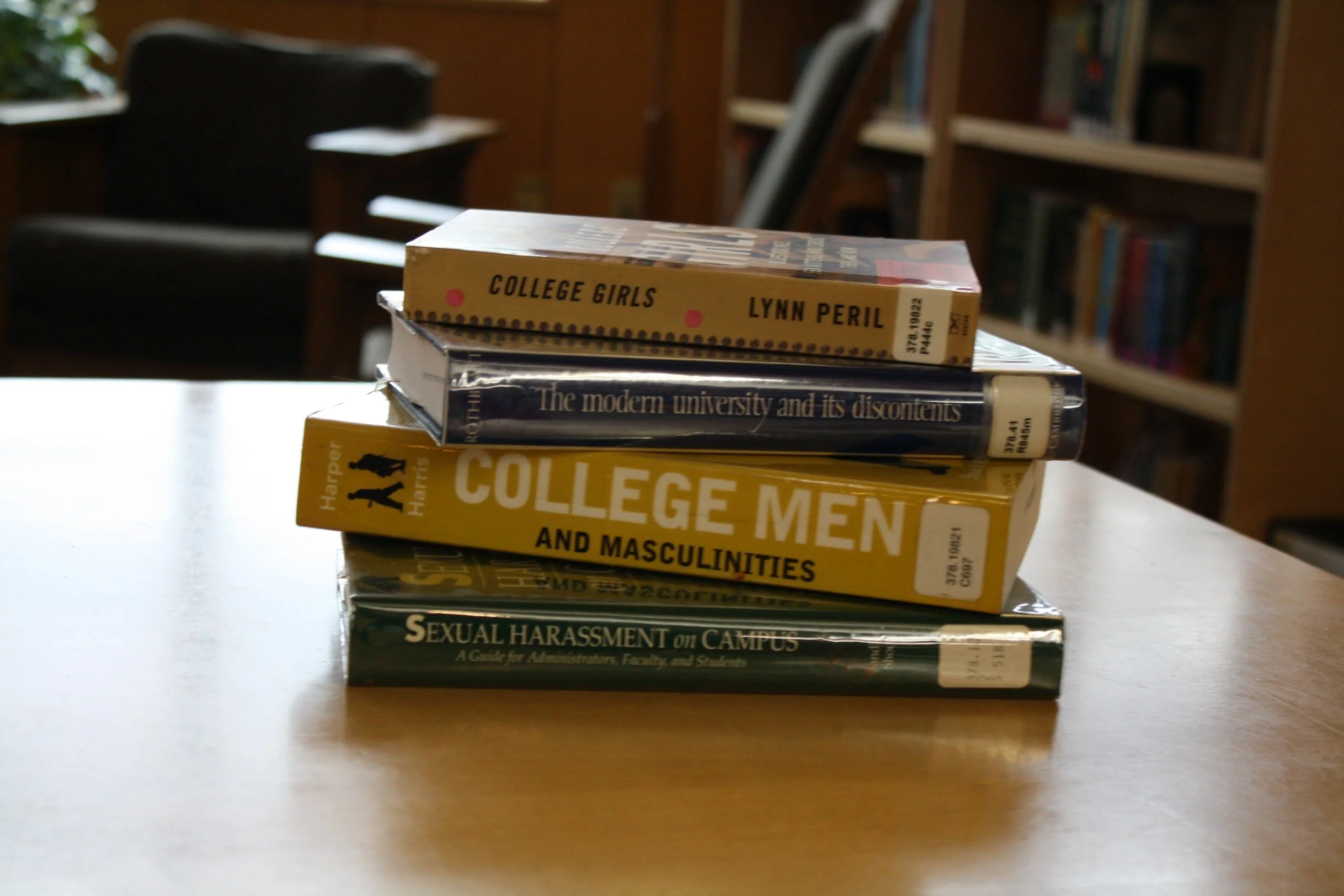
A stack of books on topics ranging from masculinity to sexual harassment on college campuses sit on a table at Warren Wilsons College’s Pew Learning Center & Ellison Library, Swannanoa, N.C. Nov. 3, 2026 (Echo/Emma Taylor McCallum)
In light of the recently revealed story of Jane Doe’s assault at Cornell University, national conversations about rape culture, complicity and what it means for institutions to hold responsible students accountable have been reinvigorated. This is not an isolated incident but a public, high-profile example of rape culture and institutional failure.
Though Warren Wilson College (WWC) is a small community, it is not immune to Title IX issues, and some students who have had complaints under Title IX have been disappointed with the college’s response. Several students described the experience of dealing with the Title IX office as more stressful and upsetting than the incident they were trying to report itself.
According to WWC’s 2024 Annual Security and Fire Safety Report, there has only been one case of stalking, one case of dating violence and seven cases of domestic violence between the years 2021 and 2023. Though more recent data has not yet been published, student opinion indicates that these numbers are likely higher, but due to lack of confidence in the Title IX office, many incidents are not reported or may not be elevated to a formal complaint.
One WWC student, who will be referred to as X, had supportive measures instated against another student a few years ago. X described their experience when attempting to have their protection maintained during staffing changes in the Title IX office.
Students emphasized that the existing culture at WWC has an important role to play in shaping student willingness to report. “I think if any of us knew one person who had ever successfully filed anything and ever had any repercussions occur from it, then there would be more people, seeking some sort of like, like repercussions for wrongdoing because [they would feel] they were backed up to do that,” X said.
WWC is required by Title IX of the Education Amendments of 1972 “to ensure that all of its education programs and activities do not discriminate on the basis of sex” according to Warren Wilson College equal opportunity, Harassment and Nondiscrimination Policy which includes .ut is not limited to protections against gendered violence and sexual misconduct.
Joel Bluml has been the Vice President of Student Engagement and Dean of Students at WWC since July 1 of this year. As a consequence, he deals with Title IX issues.
“[There are] four very specific things [Title IX covers:] sexual assault, dating violence, stalking [and] domestic violence,” Bluml said. “We really try to put the complainant, if you will, in the driver's seat, so they can make an informed decision about what's best for them related to the process.”
There are three main outcomes that students can seek when reporting a Title IX issue: supportive measures, such as no-contact orders or adjustments of classes; an official complaint with an informal resolution where students can go through a mediation process; and an investigation and decision-making resolution with a live hearing.
The Trump administration finalized a return to the pre-2020 Title IX regulations in September of 2026, meaning that Title IX complainants seeking investigation and decision-making must participate in a live hearing with cross-examination for sexual misconduct cases. This change imposes a higher burden of proof when compared with the Biden-era regulation’s “preponderance of evidence” standard used to determine whether it was likely that sexual misconduct had occurred.
Dr. Pam Foster, pulled in from retirement, was appointed interim Equal Opportunity Director, Title IX coordinator, and athletic compliance officer at WWC. She has worked with Title IX issues for many years at several different institutions, and noted the changes she has seen in student reporting since changes to the federal regulations under the Trump administration as well as the effects of COVID-19 in 2021.
“I rarely get students that come in and file sexual assault complaints, and the ones that do don't want to go to investigation,” Foster said. “They want to just access the supportive measures that are available to them. So I do think [the regulation changes under the Trump administration] had a chilling effect.”
At WWC, some students feel that even when they try to access supportive measures or an informal resolution, there are hurdles and administrative challenges with implementing these protections. These worries are exacerbated by the high turnover rate in Title IX and conduct-related positions at WWC. This lack of continuity can sometimes cause students to feel they have been left in the lurch.
“[Bluml] told me my [supportive measures] were invalid and therefore [he] could not continue them or do anything more unless I wanted to have an entire case opened, and go about the entire process all over again,” X said. “He clearly did not want to [open the case] and was very clearly swaying me towards not doing that.”
Difficulty maintaining the continuity of supportive measures can cause students significant distress as well as safety concerns. Another WWC student who has undergone the Title IX reporting process and will be referred to as Z, described a meeting with Bluml.
“Over the course of 20 minutes, I realized I have no support anymore and everything I had previously thought was still in place is completely gone,” Z said. “It was a feeling of your entire safety net just being ripped out from under you.”
Experiences like these have resulted in a lack of student confidence in the Title IX office. This impacts whether students feel they can report issues they are facing while being protected by the school from potential repercussions from the perpetrator.
“I was on the brink of tears in the meeting just for how completely unsupported and illegitimate I felt, like [they were saying] ‘You are being dramatic,’” Z said. “[Bluml] told me to inform my professor that I was having ‘girl problems’ or ‘drama’; that it might be a little difficult for me and to just let them know ahead of time, in case it impacts my performance. I was told to get a bracelet with an inspirational quote on it. That's laughable.”
Students pointed out how the school’s handling of conduct cases directly influences campus culture and how transgressions are viewed by the student body.
“[Student opinions] can be traced back to the way that our administration handles things,” Z said. “[If] someone had something go wrong or something done to them and they reported it and it was taken seriously by the school and appropriate action was taken, I think a lot more people on campus would treat issues seriously.”
Bluml described how he is working with Foster to solidify policies and ensure the office is compliant and institutional policies are in place so that when there is more turnover, structures are in place to ensure things do not fall through the cracks.
“If you're dealing with a system that's not set up right, it just compounds [the issue] and you don't want to have people being victimized in a way [that causes] a chilling effect on reporting,” Bluml said.
“Even if things are done well, and the Title IX process would be graded at an A+, you still run the risk of students feeling that they didn't feel heard,” Bluml said. “Often [when] there's a finding or a resolution, 50% of the people are often going to feel that way, either respondent or the complainant, depending on which way the decision goes in relation to the evidence that's presented.”
Foster emphasized the need for cross-campus collaboration.
“[We are] working on revising the website so it has a little more information, or better information,” Foster said. ”The other thing I'm gonna try to get done is meeting with Counseling and Health [Centers] to find out what we can do here on campus to have support for people.”
Foster also mentioned creating structures for students to have more support in the event of a rape case, particularly providing easier avenues for WWC students to visit a SANE (Sexual Assault Nurse Examiner) in Asheville, since that service is not currently provided on campus.
These changes would hopefully leave the office in a better position to incorporate the new Title IX coordinator next semester when Foster’s interim position ends.
Another student described their disillusionment with the Title IX process at WWC after WWC did not uphold the supportive measures promised.
“There were multiple times where [parts of the supportive measures that were in effect were] broken. It was discussed that there would be repercussions if these things happened and then they happened and there were no repercussions,” student Y said.
While the Title IX Office works to improve its procedures and the search for a permanent coordinator progresses, there is still much that needs to be done in order to regain student trust and build a campus culture that encourages and supports students.
Students emphasized that while the college administration and larger cultural forces have a large role to play in shaping the campus culture surrounding Title IX violations, the student body can also take the lead where the offices and policies may fail.
“People are waiting to be told whether or not something's bad,” Z said. “ I think as a community, we should make those decisions for ourselves more often. We should protect the people that are around us and that are near and dear to us…You don't need some dude to tell you that you need to care about your friends and their well-being.”