

New Projects Bring Climate Collaboration To Campus
Solie Lawson | Nov. 18, 2025
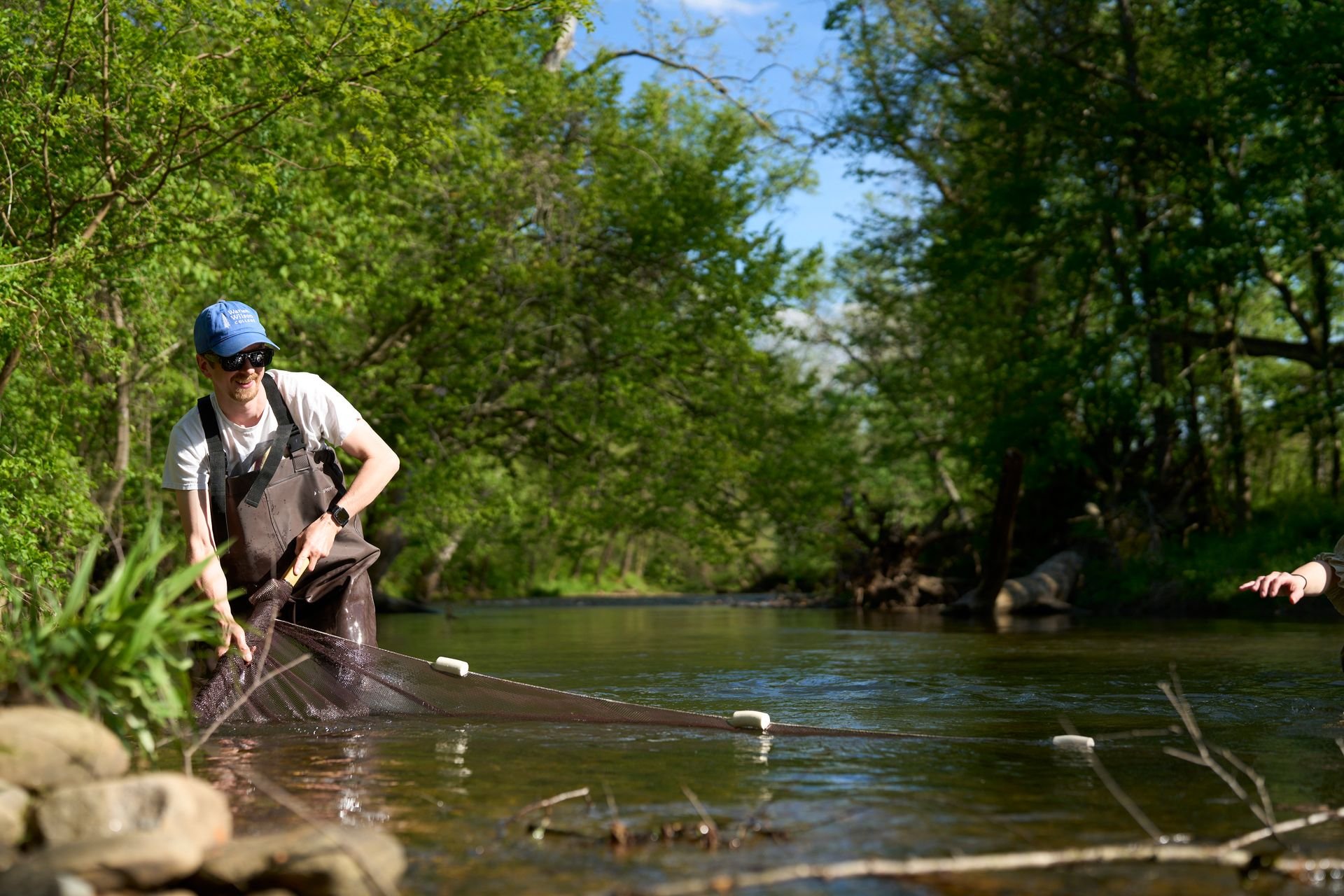
Professor Patrick Cicotto wades in the Swannanoa River in Swannanoa, N.C. (Warren Wilson College)
Many students on campus have heard of the Climate Action Now (CAN) program, but have been unaware of what it entails. CAN is a program dedicated to creating action to address climate change through campus-wide collaboration at Warren Wilson College (WWC). Several groups on campus have earned specific grants to achieve their goals, addressing different facets of the current climate crisis.
Willow Solomon is a senior who works at the Kittridge Arts Center. Her CAN project is focused on Graph-Based Weather Regime Detection. She discussed how professor Christopher Potvin got her involved with the graph-based program in the spring semester, and she conducted research over the summer.
“I got [grant money] for doing my research over the summer, and [was able to] understand what these graphs that I'm looking at [are] and what they mean,” Solomon said.
The project focuses on the analysis of weather and air movements, specifically in data samples, using chaos theory. Chaos theory is a branch of mathematics that deals with complex systems that change according to conditions. Solomon talked about how applying theories can sometimes bring trial and error.
“There will be times where I'll look at an algorithm, and I'll read all about it, and it'll say, ‘This is a very efficient algorithm,’” Solomon said. “Then I use it, and it's bad. It's [about] understanding both theory and practice.”
Solomon’s project has expanded into the basis for her senior capstone. She expressed how important it is to have this knowledge and be able to use it for the betterment of WWC’s environment and the environment as a whole.
Patrick Cicotto is a professor in the biology and chemistry department who started his CAN project in the summer, similar to Solomon. Cicotto’s work is focused on the restoration of the American Water Willow, particularly in the Swannanoa River. After Hurricane Helene, there was massive flooding and storm damage to stream habitats, and the clean-up efforts removed a lot of the river’s vegetation. The goal of the project is for WWC to be the main source of the revitalization of the water willow so that it can return to growing naturally where it was once a native species.
Cicotto received a CAN grant for this project because it is focused on developing tools for the restoration of the water willow, which is integral to the aquatic organisms in its ecosystem. The hope is that willows will be initially grown in aquatic holding tanks before they are moved to the Swannanoa River. Cicotto expressed the importance of the grant not only for the restoration of the water willow but also for building community.
“I think this [grant] is a great way to not only fund those projects, but importantly, really engage students to get experience with climate science and climate justice, and all you can learn while working to help out the local community,” Cicotto said.
Cicotto is hopeful for the future of the water willow project, and feels that there are current measures in place that will allow the effort to be successful.
Charlotte Taylor is an associate professor of art. Their CAN endeavor entails an initiative for resistance, resilience and restoration in the form of building a garden near the Holden Arts Complex. Taylor talked about their distaste for the current Holden area, which they see as a sea of beige buildings that lacks the typical WWC aesthetic. They also plan to use the area as teaching space and will use the garden to create pigments.
The CAN grant proposal for this project was written in the spring by Taylor, Kathryn Cellerini Moore who is the assistant professor of painting and drawing, and Jen Kaplan who is the assistant professor of ceramics. The grant will provide money for supplying seeds and plants for the garden, as well as building supplies and planters. Taylor wants the garden to connect the WWC community with the land.
“The more we can do to be place-based and ecological and source our own materials, the better,” Taylor said. “I think it will be [better] for the planet, but also for us as artists and practitioners [to have] a relationship with the land.”
Ennis Shepard is a junior on the Holden Arts Crew, and was brought onto the project with landscaping. His job focuses on putting down the grass and mulch for the raised beds of the garden. Shepard talked about how important it is to apply action instead of just thought to the global issue of climate change, and how the garden project will apply some of that needed action.
“I want [the CAN project] to continue to educate people and inspire people, not just on campus, but outside of campus and show that if you just put the effort into it, not only can you make a difference, but you can make something cool,” Shepard said.
The CAN program allows for students and faculty to take steps in helping the climate and the environment in the midst of change. The CAN grants, along with the motivation of each of the teams who received the grants, help the WWC campus to flourish and put its values, like sustainability, into practice.