

"Be Curious About the Places You are Going": Warren Wilson’s Land Acknowledgement
Sophie Aguilar | Nov. 25, 2025
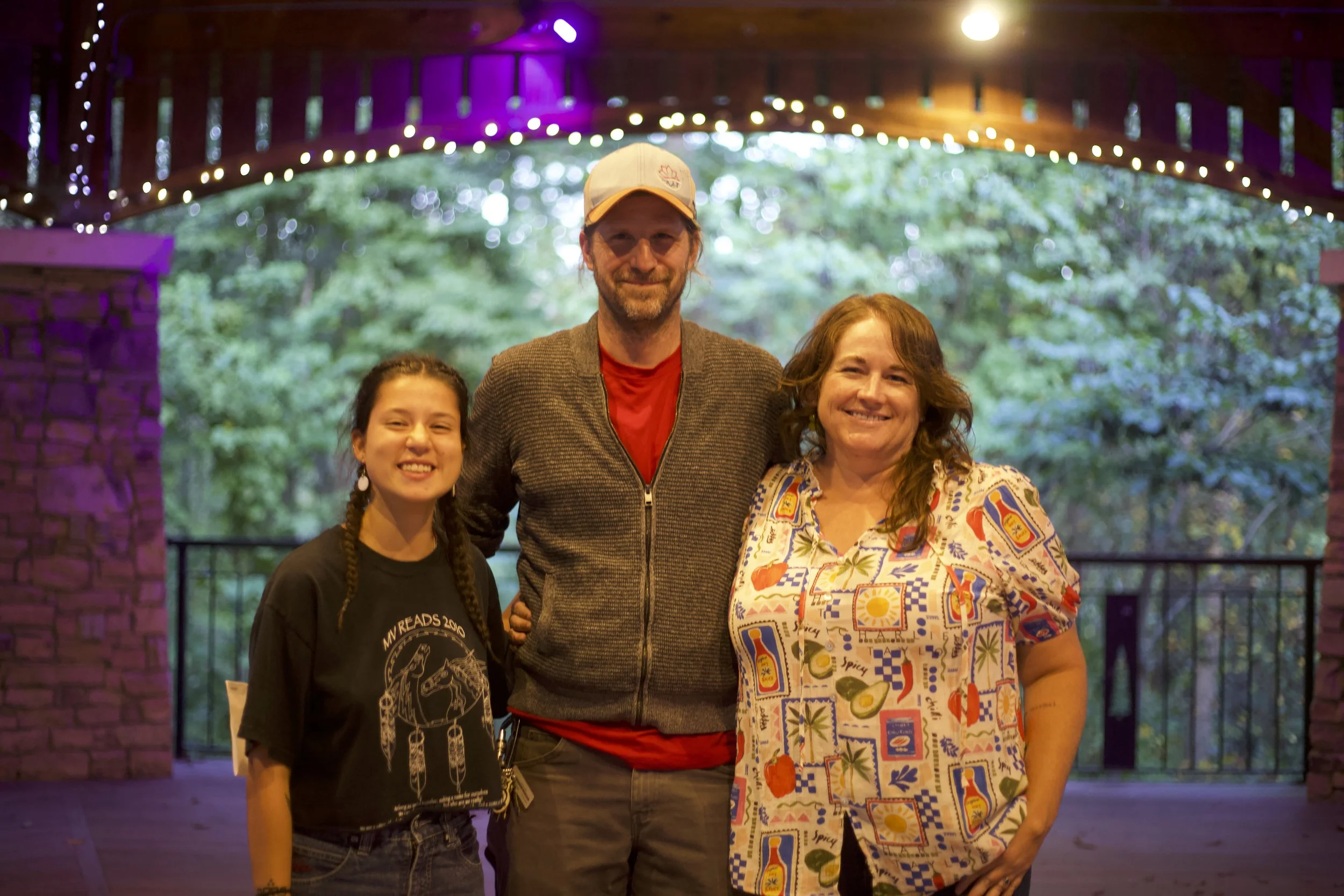
Jetta Ghosthorse, Eric Griffin and Scotti Norman pose for a photo at a land acknowledgement October 10, 2025 at Warren Wilson College (WWC) in Swannanoa, N.C. (Echo/Emma Taylor McCallum)
Jetta Ghosthorse is a senior and one of the starting members of the Land Acknowledgement Committee (LAC) at Warren Wilson College (WWC). Ghosthorse started the LAC their sophomore year after expressing concern about the lack of recognition and education about the rich history of the land on which WWC resides.
“How do we not only create representation for Indigenous identity, but also to acknowledge the land we’re on, and almost create a voice for the land too?” Ghosthorse said.
The LAC’s purpose is to acknowledge the land on which WWC resides and the history before the school’s founding in 1894, and to create a deeper understanding and connection with the land.
“I think there are lots of different reasons why [the LAC is] important,” Ghosthorse said. “Mostly to acknowledge the history of this land prior to the school’s founding. I really do think when we integrate a history and knowledge base, that’s so beyond our conception of time, we actually enhance our ability to learn and connect with a place.”
Scotti Norman is an assistant professor of material culture and archaeology and a member of the LAC. Since working closely with the land and the ancestral people who have cared for it, Norman felt upset with the lack of land acknowledgement given the school's pride in land stewardship. Norman emphasises the importance of education to gain a deeper understanding.
The LAC recently held a meeting with the president’s council to share its proposal for how to better integrate the land acknowledgement into the WWC world. This includes integrating educational efforts surrounding Indigenous representation and traditional ecological knowledge into learning opportunities, adding material markers to identify specific Indigenous regions, plant and animal species, giving a better understanding of the diversity of Indigenous identity and many other ideas to benefit the WWC community. The council unanimously approved the Indigenous Representation and Right Relationship Proposal and invited the LAC to present at the next board of trustees meeting in February.
“There is a significant gap in the communal knowledge of the land and human history upon which WWC was built. Warren Wilson College participates in settler colonialism, having benefited from the violent seizure of ancestral lands from the Cherokee. There is an overt neglect of recognizing the land of this College and its history prior to its founding in 1893/1894. To address this gap, we will develop appropriate educational materials and collaboration in classroom curricula, academic programs and centers, faculty and staff development and community engagement,” the LAC said.
“Until other people start also seeing this as critical and as something we’re talking about in class or when they’re out working on the land, until that conversation is practised regularly, I think we still have a long way to go,” Norman said.
Eric Griffin is another member of the LAC and a professor of ecological forestry. Griffin hopes that the LAC and its work will help students feel safer and improve everyone’s knowledge.
“There is a great opportunity to work on educating and promoting more voices in a way that was inclusive to particularly Indigenous communities, and to recognise that the land stewardship practices that we’re trying to emulate today largely have been drawn from Indigenous practices on the land,” Griffin said. “After European colonisation into the Americas, it actually began decades and decades of mismanagement and stewardship practices that were actually harmful to the environment.”
The committee believes in the importance of speaking up for what they are passionate about.
“Although we may be considered a progressive place where we can voice our opinions and discuss them, we still live in a larger societal framework within our institution that suppresses knowledge and people and backgrounds that promote things that our society doesn’t want to really talk about or acknowledge,” Ghosthorse said.
Focusing on the history of the land on which WWC resides before the school’s founding is a critical part of being able to connect with the land. The LAC is putting in tremendous effort to help the community gain knowledge and understanding of this history. WWC students and community members can help expand their knowledge by attending the events and presentations that the LAC puts on and participating in volunteer events that the LAC hosts.
A snippet from the (LAC) proposal document reads this: “At Warren Wilson College, we honor the Anikituwagi, known to us as the Cherokee. We read this acknowledgement in times where the community comes together to practice loving care to honor those who came before us. We are guests on this land and yet integrally a part of it, and we are responsible for its care. We solemnly and respectfully recognize that the land on which WWC currently resides is the ancestral land of the Cherokee (Eastern Band of Cherokee Indians, United Keetoowah Band of Cherokee Indians and the Cherokee Nation). The Cherokee called this land Togiyasdi, meaning ‘Where They Race.’ The land was a place of trade, ceremony and culture and the story of the people here neither begins nor ends with the arrival of Europeans.
We understand and acknowledge that the land was violently wrested from the Cherokee in the late 18th century after years of violent conflict and that the Cherokee ancestors were forcibly removed from the land through the 19th century. We recognise that this act of acknowledgement does not repair the history, but is a first step toward forging a new relationship grounded in mutual respect. As these words are spoken or read, we reaffirm this campus as Cherokee homelands.”