

Higher Education is Embracing AI in the Classroom: What Does This Mean for WWC?
Elliot Hove | Oct. 20, 2026
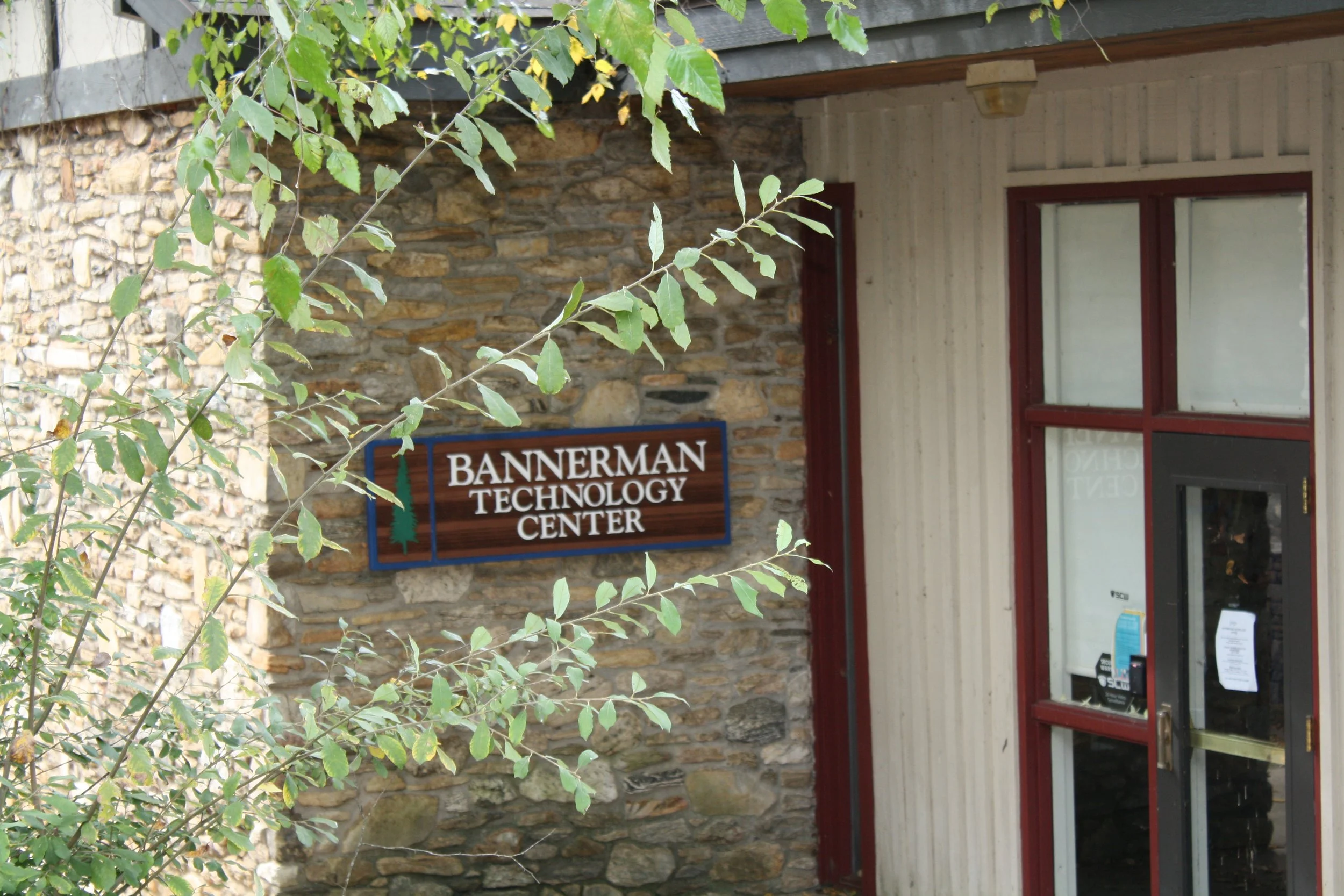
Bannerman Technology Center at Warren Wilson College on Oct. 9, 2026. Swannanoa, N.C. (Echo/Emma Taylor McCallum)
With the ever-continuing proliferation of generative artificial intelligence (AI) in daily life, the question of its role in education progressively comes into the foreground. The proverbial “testing grounds” of this dilemma seems to have found its place especially in higher education, as seen by a recent release from Columbia University. The article, focusing on striking the difficult and ever-complicated balance between understanding AI and compromising academic rigor poses an interesting question for the Warren Wilson College (WWC) campus community: what role do we want AI to play in our college education, if any at all?
Finn Mckenny, a sophomore on The Echo Crew, expressed concerns over the college moving toward increased AI integration. Mckenny, who was previously on the Information Technology (IT) Crew, primarily cited concerns about its heavy environmental impact compared to non-generative models.
“I came to [WWC] because it seemed super environmentally friendly… I want a school that, as a whole, follows my morals [in relation to my] environmental science major,” Mckenny said. “As a school that is so dependent on [its] land, I wish it took a stronger stance on being anti-AI.”
Of course, the scope of AI’s influence goes far beyond the WWC campus. As the article from Columbia University notes, a prominent argument of supporting AI in higher education stems from not automating every human experience, but being “AI ready,” as evidenced in a quote from Nvidia CEO and cofounder Jensen Huang. Nvidia is a technology company primarily focused on developing graphics processing units and application programming software.
“You’re not going to lose your job to AI, but you’re going to lose your job to someone who uses AI,” Huang said in a conference in Beverly Hills.
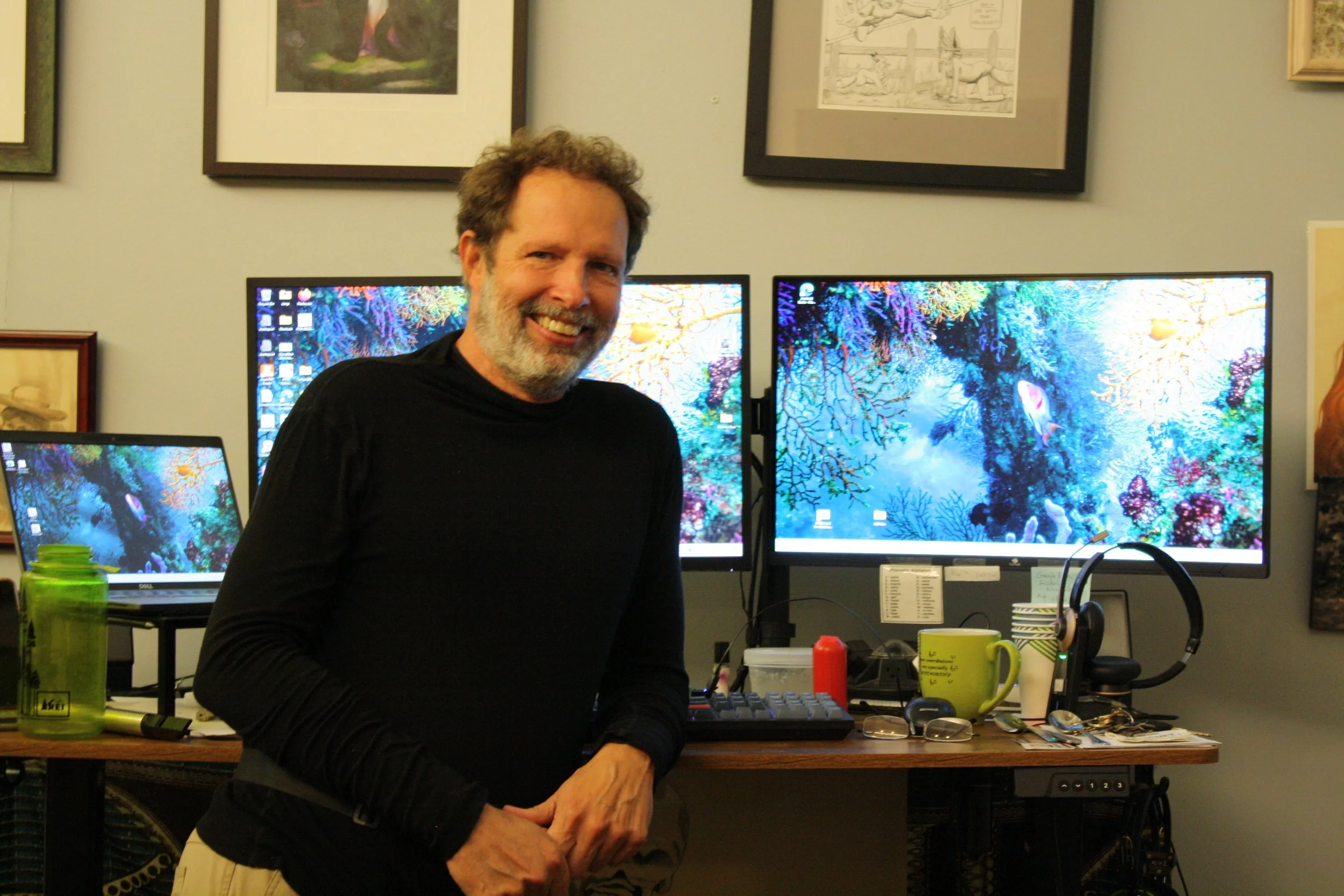
Mars Landis stands at his desk in the Bannerman Technology Center at Warren Wilson College on Oct. 9, 2026. Swannanoa, N.C. (Echo/Emma Taylor McCallum)
This sentiment has its echoes on the WWC campus. Michael Mars Landis, Director of IT, considers that WWC’s “Progressive Promise” entails giving students the tools necessary to adapt to the world beyond campus.
“My first and foremost goal is to see the preservation of the college in its operations and in its mission and vision… that means that first and foremost, our students need to be prepared to enter into a world where expertise in the use of these tools is required, not expected,” Landis said. “We are quickly moving into that world… my realization is that if we don't do that, then we're failing our students.”
Landis, who has been put in charge of overseeing WWC’s AI initiatives, added that a crucial aspect of sustaining the college is having critical conversations on how to internally use these tools in the most responsible way.
While it is true that AI’s presence in the world grows more prevalent each day, perspectives on campus reflect a varied response to whether or not AI will play a role in their own future after college.
“There are fields in which [generative AI] is helpful… but I feel like AI is just disintegrating people's common knowledge,” McKenney said. “I don't feel like it adds to [professional] competition. Anyone can be fluent [in] using AI.”
McKenney also highlighted a major concern of AI usage is its propensity to fabricate information and present it as factually sound.
But how do campus perspectives on generative AI translate after students graduate? Tyson Lewis, class of ‘25, revealed the role AI has played in their professional life after college.
“I applied to a job [and] didn't get [it] … But after [a while] they reopened hiring,” Lewis said. “The only thing that was done differently between the two times is I ran my resume through ChatGPT and [drafted] a resume based on inputs for this kind of job… I actually landed a bunch of interviews, but the company was really evil, so I turned it down.”
Lewis, who was on the Writing Studio crew, said that AI’s role in their campus work was minimal. However, they have seen a dramatically increased proliferation of AI's presence in writing even just two years since their graduation. Given this recent and rapid influx, Lewis highlighted what they believe generative AI in WWC’s education should look like.
“I think any academic institution has the responsibility to react to whatever is happening in broader society. I don't think academia should be a bubble away from AI… That’s [not] realistic,” Lewis said. “But academics and researchers have the social responsibility to [not] wholesale embrace [AI] and go with this trend without stepping back to really think about the nuances.”
As discussions around AI’s role in the modern age continue, Landis added an opportunity for WWC students to have their voice heard at the Human Intelligence Commission.
“[The Human Intelligence Commission is] an initiative to scope out what aspects of our educational process and our operational process that we want to guard as being uniquely human,” Landis said. “[Its purpose is] also to ensure that humans stay involved in the process, even when machines augment it.”
While the application for the Human Intelligence Commission is closed, students can be on the lookout for an update from the Commission by end of Fall Term as per the charge sent out earlier this semester.
The role of AI in higher education has become increasingly contentious as AI becomes more integrated into other aspects of daily life, but as Lewis attests, how this technology is used is ultimately up to us as individuals and as a community.
“Insofar as the dominant power structure is banking on AI automating a large swath of the job market, understanding AI is going to become more important,” Lewis said. “We can't change it from the inside, but we have to know how it functions… we should know it in the way that you must know your enemy, not as a well-embraced friend.”
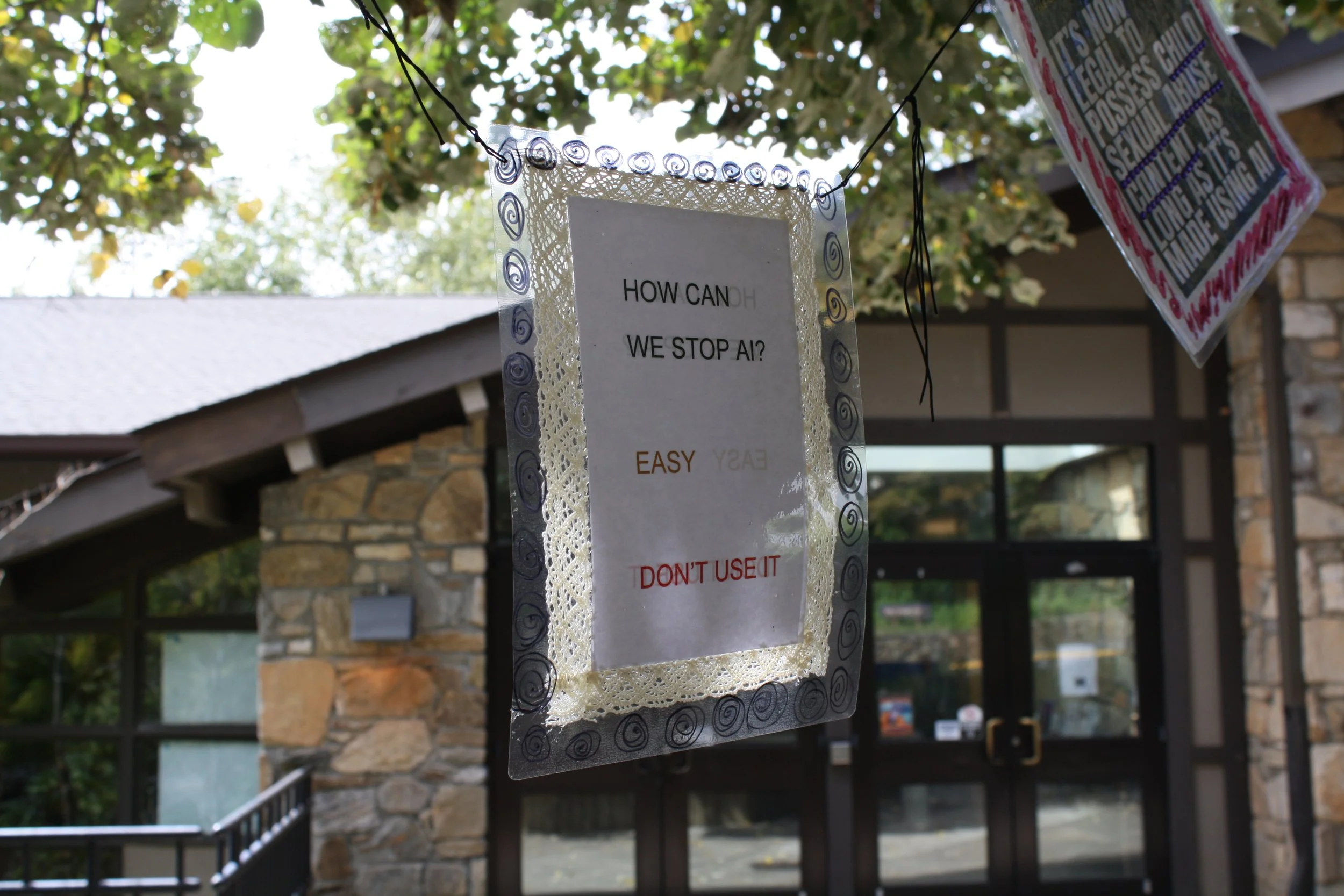
A sign reading “How do we stop AI? Easy. Don’t use it.” hangs from the tree outside of Gladfelter at Warren Wilson College on Oct. 5, 2026. Swannanoa, N.C. (Echo/Emma Taylor McCallum)