

Rev. David Black Speaks at WWC on the Radical Possibilities of Religion
Ryleigh Johnson | Sept. 29, 2026
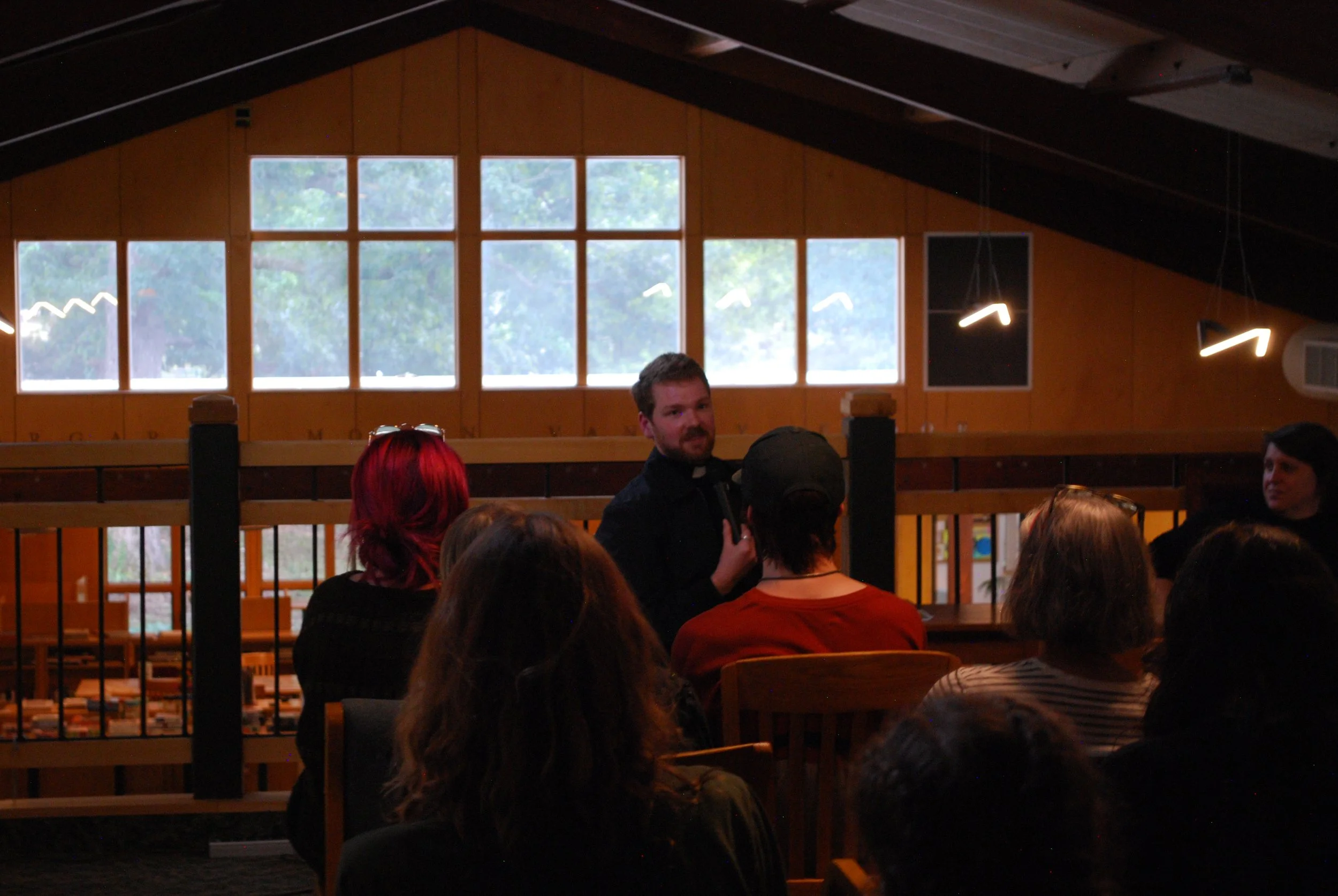
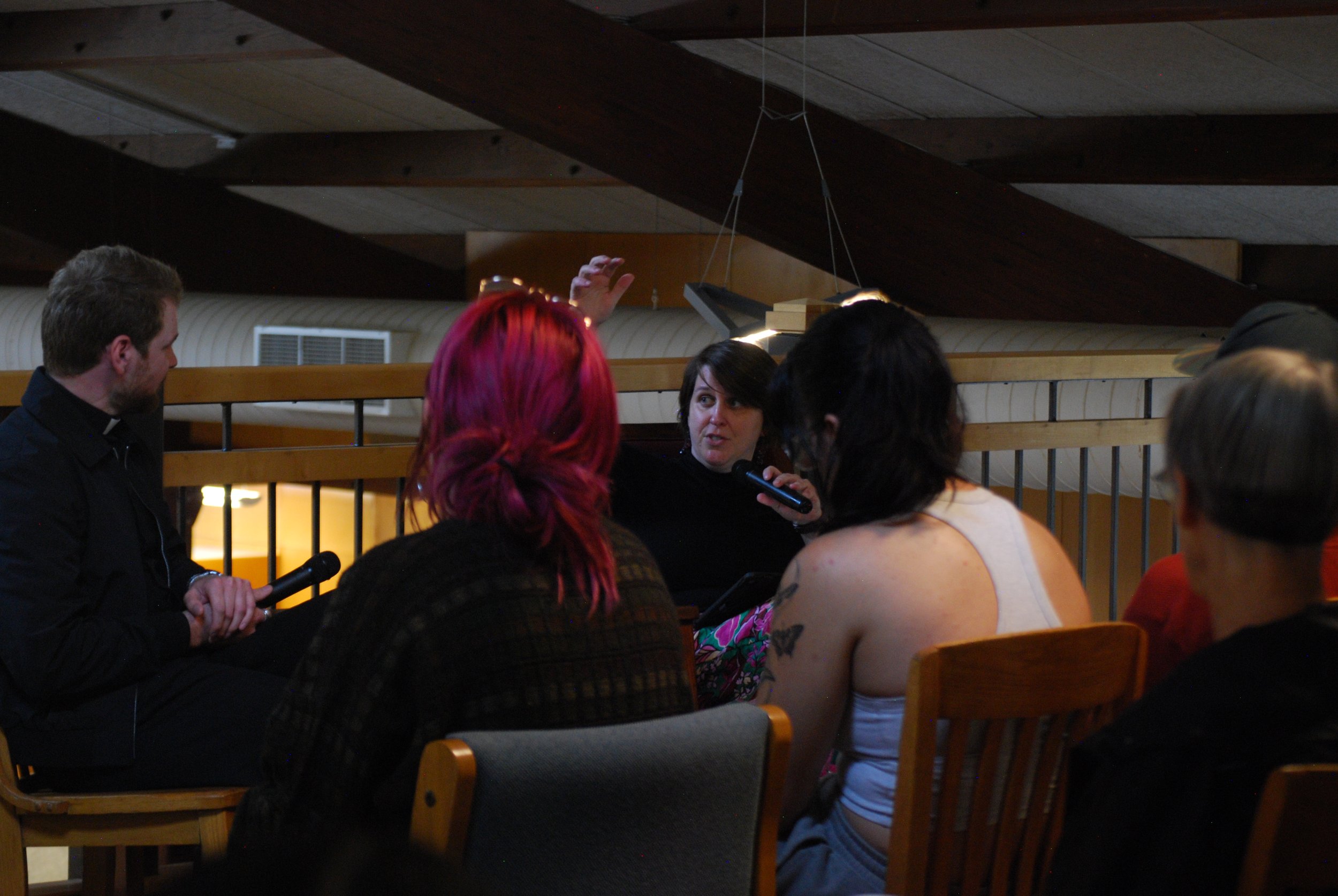
In an era of American life where religiosity is on the decline, people are losing trust in institutions and despair is on the rise, how could one make a compelling case for the power and necessity of faith in the face of a world that is “on fire?” On Sept. 23, Rev. David Black, Senior Pastor of The First Presbyterian Church of Chicago, in conversation with Rev. Jessica Rigel, Pastor of Warren Wilson Presbyterian Church, attempted to make the case for faith as a grounding, catalyzing force for social justice.
Black gained notoriety in 2025, when a video of him being shot with pepper balls by Immigration Customs and Enforcement (ICE) agents at a detention center in Broadview, Ill. went viral.
“I got there and I just wanted to tell the ICE agents that they're sinning and to please repent and believe the good news,” Black said. “We were all seeing evil manifest right in front of us. I just really wanted to see an ICE agent take off his body armor, put down his gun and be like, ‘You know what? Yeah, I am still a human.’ So I stretched my arms and invited them to repent and they started shooting me in the head.”
After videos of the altercation began to spread, Black joined Chicago Headline Club v. Noem, a lawsuit sponsored by the ACLU that sought to restrict violent use of force by federal agents in Chicago. His response to the violence of the ICE agents he encountered in Broadview has been complex, calling for both accountability and compassionate forgiveness while trying to understand the perspective of the agents who shot him.
“I think that there's a very compelling case to be made that the violence already exists, that inviting the ICE officers to repent is a form of violence to their hearts, to their feelings, to the system that needs them to be enacting its evil because a system doesn't have a will of its own without acting through people,” Black said. “Maybe shooting protesters is proportional to the threat of calling human beings to be human again.”
Black’s interactions with ICE predated this incident, with his activism beginning in 2018 while working in New York City.
“One of the first exposures I had to ICE was [in a] waiting room,” Black said. “There are no windows. The door is locked from the other side. You sit there and you wait and you wait...until ICE officers come in and they say something like, ‘It's time to move the body,’ and then they go and get the next person for their appointment...I saw firsthand at that time the ways that these ICE agents were very deliberately trained to dehumanize the people that they were there to collect and move and deport.”
These experiences are part of what led Black to get involved in demonstrations happening around the detention center in Broadview, and have reinforced his evolving conception of what it means to be a person of faith. Black acknowledged that many people feel as though Christianity in the U.S. has been weaponized to further right-wing political agendas, while offering an alternate vision of the possibilities religion presents to him.
“The basis for hope tends to be shaky at best, I find,” Black said. “I think as people of faith...we can offer at least a center of gravity where we say, ‘Even if you don't believe it, I will believe it for us – that this is worth it; that there is a new creation on the way and it will be here in this generation or the next.’”
Black expanded on this idea of the new creation, taking a moment to “quibble” with a remark Rigel made about the “possibility” of a new creation being “on the horizon.”
“Jesus says it's at hand, and that means, if you reach out your hand and you feel somebody there, that's the new creation,” Black said. “Whatever is here is a part of that. It's not something we're waiting for. It's not a utopian ideal. It is already here.”
This ethos is exemplified in Black’s church in Chicago, which has become a hub for artists and activists, creating a space where Black hopes people can leave what he calls “the empire of hell” behind and reconnect to the “reality of [their] humanity.”
His passion for building community was apparent throughout the discussion, from references to the artists his church now hosts to the organizers he connected with at the University of Chicago and his repeated requests for people to try to extend empathy to those they encounter, including ICE agents.
“The torment that you can see on these people, it seems palpable to me,” Black said. “There are forces of evil that attach to people, that people become attached to in different ways. The person is never evil, but something is working through them which is evil and which is destroying them just as much as it destroys through them.”
Black acknowledged that he diverges from some other political organizers in thinking that “we should be working towards the liberation of cops and ICE agents as well.”
“It's not enough to just exclude certain people because they are evil, but we need to be looking for the redemption of all people, including those who are actively allowing evil to work through them by separating them from that evil,” Black said. “So much of the work that we do as pastors, whether it's [with] ICE agents or anyone else, [is] helping people get free of the things that are telling them, ‘I have to harm to be okay. I have to harm myself to be okay.’ Liberation is needed by all people all the time.”
Black’s hope in the transformative power of his faith was apparent throughout the discussion. Alongside this hope was his firm conviction that Christianity ought to free all people – from those detained by ICE to those doing the detaining, whether that freedom comes through protest or through prayer.